-
Deepwaters X Avalaunch: IDO Announcement
Introduction
The broken trust and absence of promise that has marred the crypto landscape over the last year has largely been the work of CeFi i.e. centralized financial institutions, private equity firms and insider-controlled projects. Unfortunately, these headline grabbing stories have come replete with scandal and corruption worthy of the soapiest of dramas; effectively conflating CeFi and DeFi to the non-native crypto population. Violations of custody have cost traders tens of billions of dollars and 2022 saw traders face immense losses from Voyager, Celsius, FTX, and others. While unscrupulous and predatory behavior is nothing new to the regulated world, the collateral damage to DeFi has been significant. Despite the seeming steps backwards, these recent mishaps fortify the case for an emergent decentralized financial system. Among the chief tenets of decentralized finance are the principles of fairness and inclusion which includes access to tradfi level trading experiences to go with inclusion and self-custody.
Deepwaters
Deepwaters is a different type of exchange that represents a quantum improvement over previous exchange technologies. As we consider the crypto exchange carnage of 2022, we must recognize that there are problems that have hounded crypto traders from inception.
Centralized exchanges control access to information and order flow. As we have seen many times, this creates misaligned incentives for privileged parties to abuse this control through internalization and Payment for Order Flow (PFOF). In essence, traders are playing against the house. Additionally, exchanges have violated the custody of traders’ assets, repeatedly losing those assets to hacks or financial mismanagement. DeFi was born largely due to the lack of trust in financial intermediaries.
Meanwhile, mass market adoption of DeFi has been obstructed by the inability of DeFi to meet the expectations established by the tools of traditional finance. Slippage and front-running create inefficiencies for large traders, and high gas/platform fees make them less accessible for smaller traders. Platforms lack composability, requiring bridges that are susceptible to hacking. Decentralized exchanges cannot compete with centralized and traditional trading without addressing predation, friction, risk, and fragmentation all together.
The failures of these systems manifest for different reasons, but affect traders similarly: risk is increased, and profitability decreases.
Deepwaters is bringing the trustlessness of DeFi to centralized finance, building the first provably fair centralized exchange. On Deepwaters, all traders have provably equal opportunity, and all orders are invisible to everyone, including Deepwaters itself, until they are executed or hit the public order book. This means:
- No front running, MEV, or sandwich attacks
- No PFOF or order internalization
- Any reordering or order flow privileges are impossible
- No adverse selection
- No information asymmetry or data bleed
Violations of custody have cost traders tens of billions of dollars. Deepwaters’ architecture ensures it can only run audited, open-source code with operations that are validated in real time by a decentralized network. In addition to guaranteeing the sanctity of order flow, this disallows discretionary actions with users’ assets, so there can be no rehypothecation or custodial violations. Deepwaters will also be able to be used in a completely non-custodial manner for further asset security, and any deposits / withdrawals occur at the speed of the relevant blockchain.
Deepwaters combines the best of centralized and decentralized platforms while adding novel functionality to provide a service which is highly efficient, compliant with regulations, yet trustless.
The Deepwaters Difference
Deepwaters solves the following problems that are present in conventional centralized and decentralized order books and automatic market makers (AMMs):
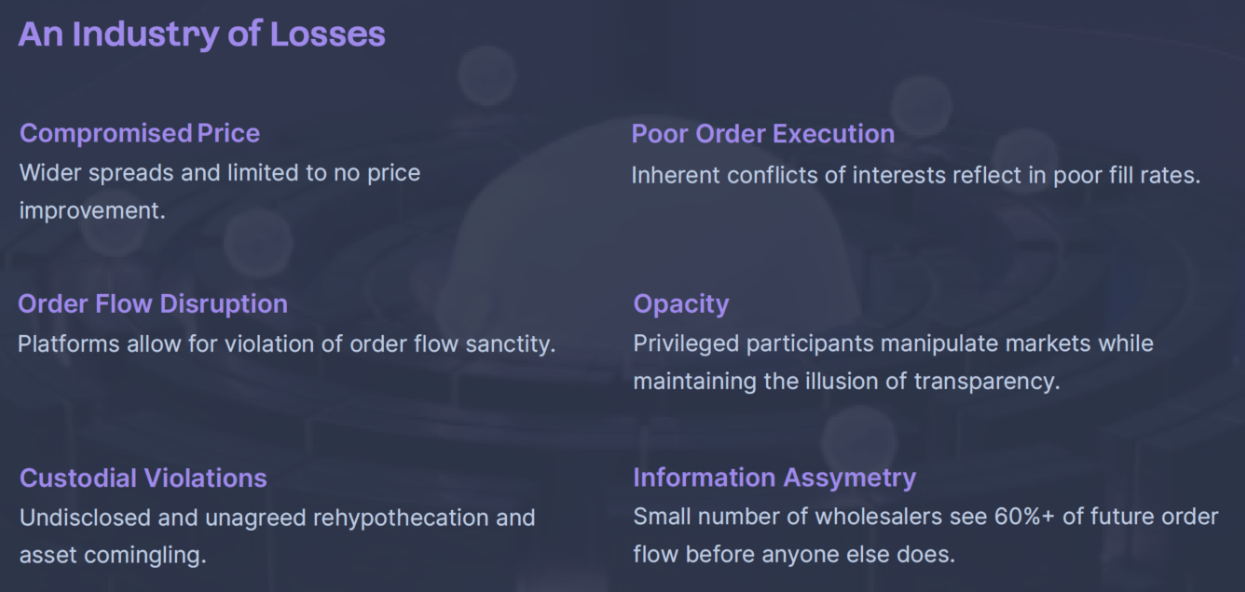
Problem Central Limit Order Book (CLOB) Invariant AMM Deepwaters Compromised Price PFOF[1] widens spreads. Adverse selection. Price Fade. Local scarcity micro economic price discovery anchored in arbitrage (invariant-based slippage + MEV-based slippage) PFOF is provably impossible Order Flow Disruption Privileged parties can change and block order flow. MEV[2] players change and block order flow Order flow Immutability Poor Order Execution Front-running and sandwiching by privileged parties. Bifurcation of orders.
MEV players sandwich and front-run traders Front-running and sandwiching is provably impossible Opacity Bid/Ask pyramid may not reflect reality (order flashing) Informational Asymmetry.
Just-in-time liquidity and other MEV-based attack vectors WYSIWYG[3] Custodial Violations Undisclosed and unagreed asset rehypothecation and commingling Immutable custody, but smart contract risk. Immutable custody, but smart contract risk. Deepwaters uses on-chain technology to support self-custody: deposits and withdrawals are done using smart contracts. Business logic and critical data are encapsulated in a TEE enclave. Independent validators are compensated to verify integrity of the system as a whole. Market participants interact with Deepwaters through technology that they’re used to: the Deepwaters Trading API and trading terminal. All business logic is open-source. Validators can subscribe to log replication and native TEE cryptographic attestation to verify that behavior is as intended. These validators are compensated to verify behavior and dispute against bad actors.
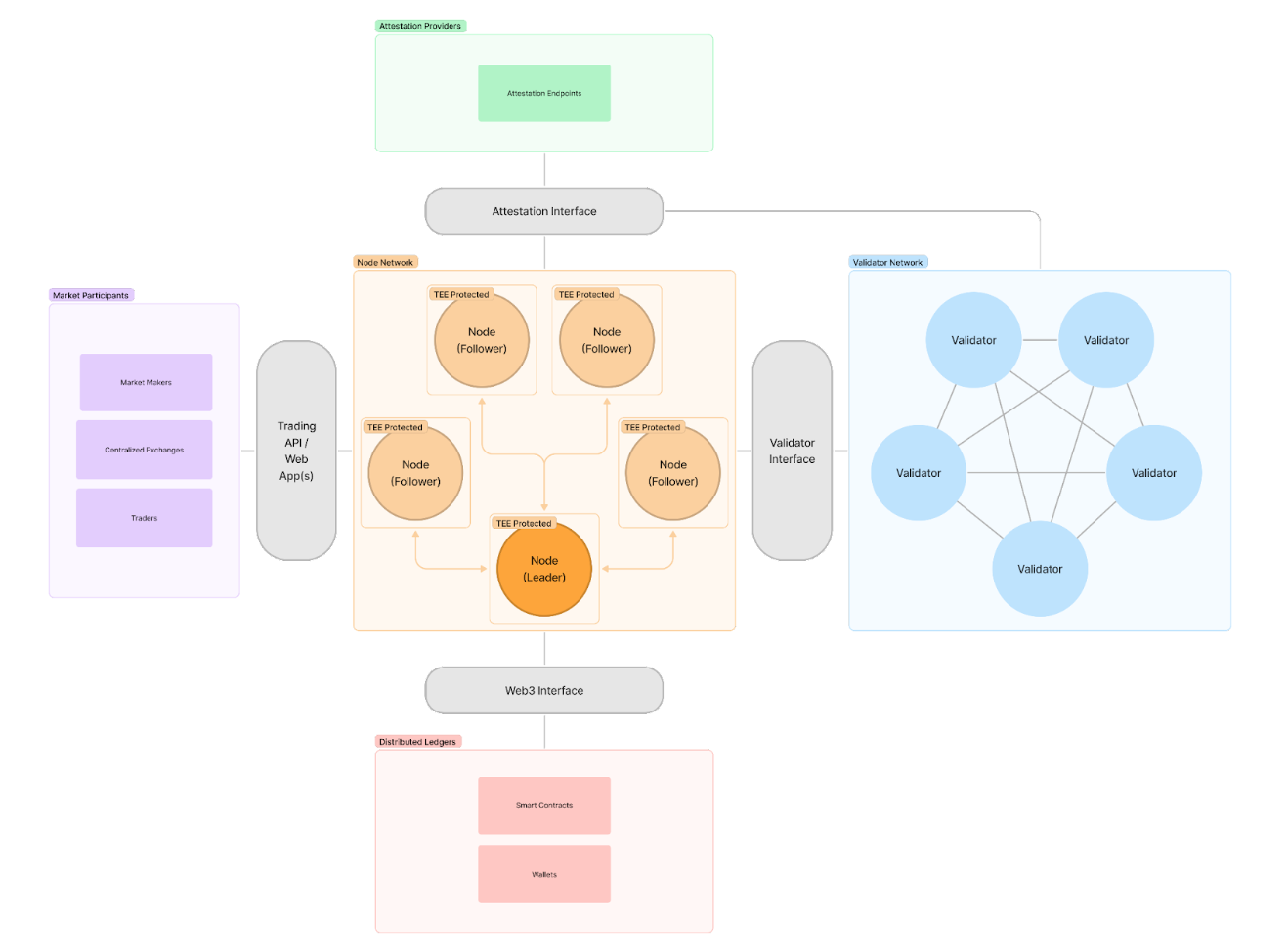
Nodes running the Deepwaters application and TEE are distributed across varied regions and participate in RAFT[4]-based consensus. In this way, the system exhibits crash fault tolerance and replication of data while maintaining high throughput, allowing for complex operations, and hindering attempts for any participant to gain advantage in speed over another by means of server colocation.
The resulting order book is public, however the integration of a TEE ensures that incoming order flow is confidential until after it is posted or matched against the existing order book. Sequencing and execution of orders is the same for all parties, including the host of the engine.
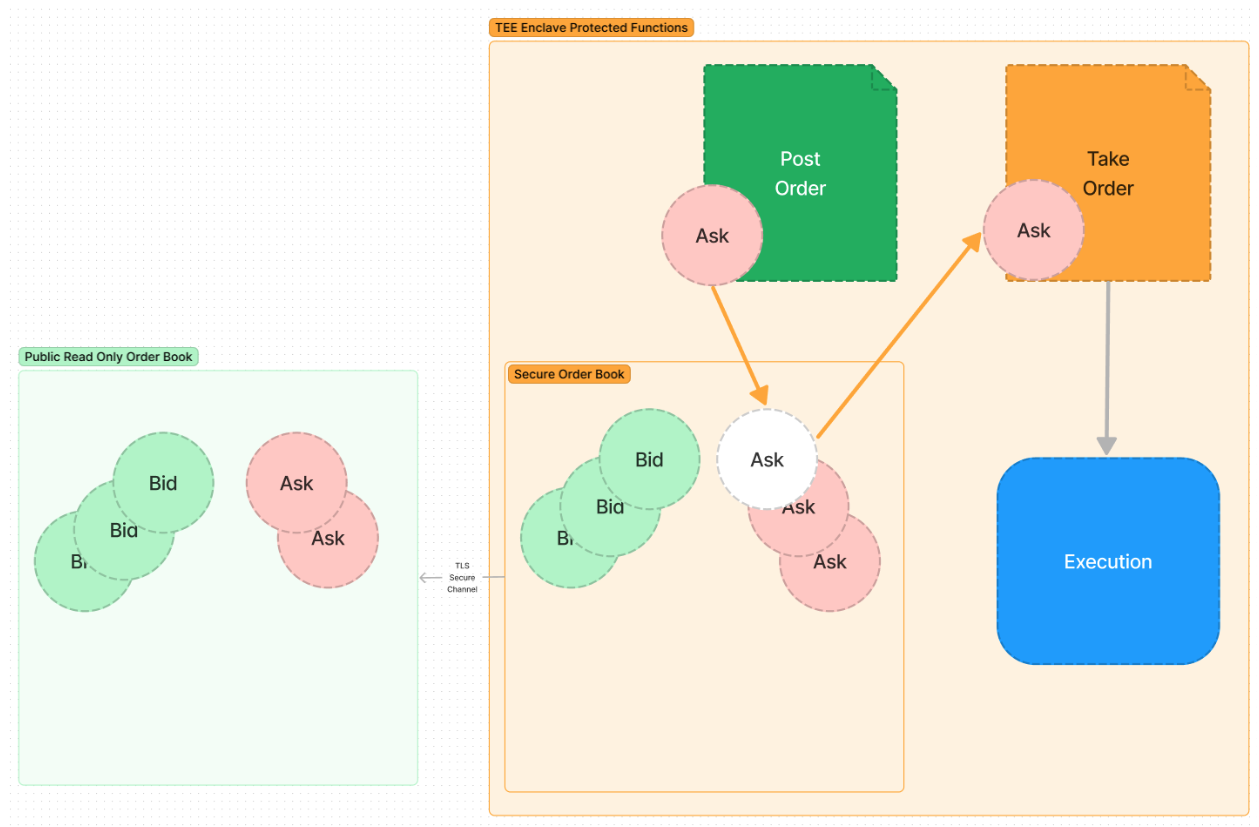
The majority of actions initiated by users will occur off-chain, utilizing the Deepwaters Trading API. A combined cross-chain state of user balances and other information is held in a secure computing environment. Actions can only be created by a user, who cryptographically proves they own the address associated with the action they are initiating. On-chain settlement is only required during withdrawals, improving system efficiency.
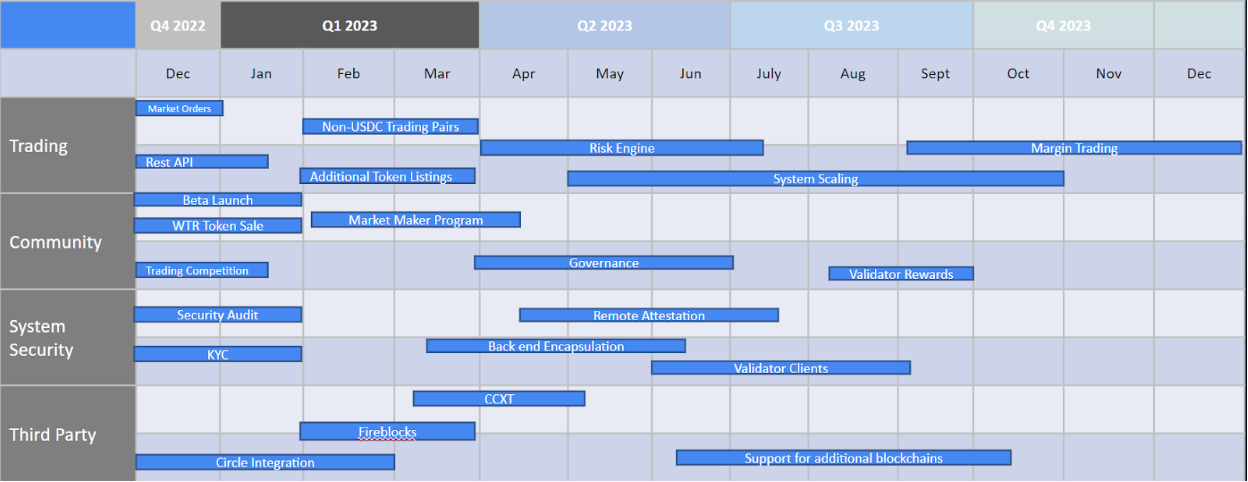
Deepwaters Beta version development pipeline.
Over 60% of exchange order flow is internalized (usually via internal netting on the exchanges themselves or payment for order flow to market makers; “PFOF”). This means orders are sold or internalized by the exchange before they hit the orderbook, and not matched to other traders. Orderbook spreads are 25% larger as a result of internalization, costing traders over $200m daily. Some or all of the price improvement is taken by the internalizing counterparties.
Internalized orders are filled slower and in a manner that maximizes adverse selection (90% more likely to happen), resulting in orders losing value immediately upon being filled.
Deepwaters is bringing trustlessness to centralized finance, building the first provably fair, centralized, optionally self-custodied exchange. On Deepwaters, all traders have provably equal opportunity, and all orders are invisible to everyone, including Deepwaters itself, until they are executed or hit the public order book. This means:* No front running, MEV, or sandwich attack
- No PFOF or order internalization
- Any reordering or order flow privileges are impossible
- No adverse selection
- No information asymmetry or data bleed
Consider the difficulties one encounters with centralized exchanges:
- Inexplicable system outages
- Hacks
- Funds concentrated in custodial wallets
- Difficulties withdrawing or depositing funds
- Frontrunning
- Improper use of customer funds: Staking, leverage etc.
- Erroneous account seizures
Conversely, AMM driven DEX’s come with their own peril:
- Impermanent loss
- Absence of order books
- Variable and costly gas fees
- Failed transactions
- Predatory bots
Deepwaters exists to solve all of these problems.
[1] PFOF: payment for order flow
[2] MEV: miner extracted value
[3] WYSIWYG: what you see is what you get
[4] The Raft Consensus Algorithm
https://raft.github.io/
Traction
- Deepwaters has had over 140,000 registered wallet addresses access its testnet. These users have placed over 7 million orders and 2.5 million trades.
- Four community members have created custom libraries to connect to Deepwaters.
- 85,000+ members in Discord, 47,000+ followers on Twitter.
- According to DappRadar & ICOdrops, in November 2022 Deepwaters was the fastest growing unreleased project in all of web3.
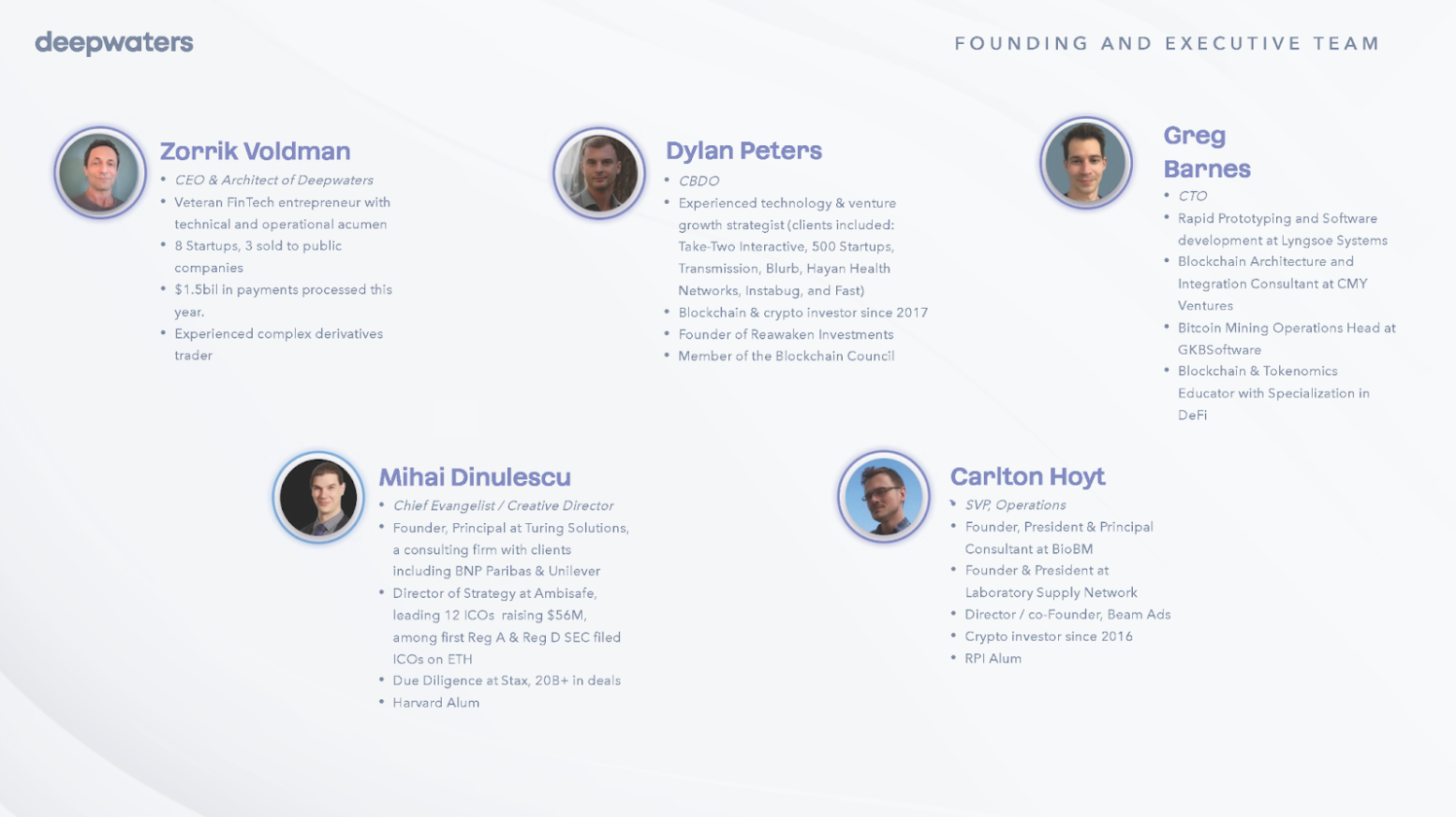
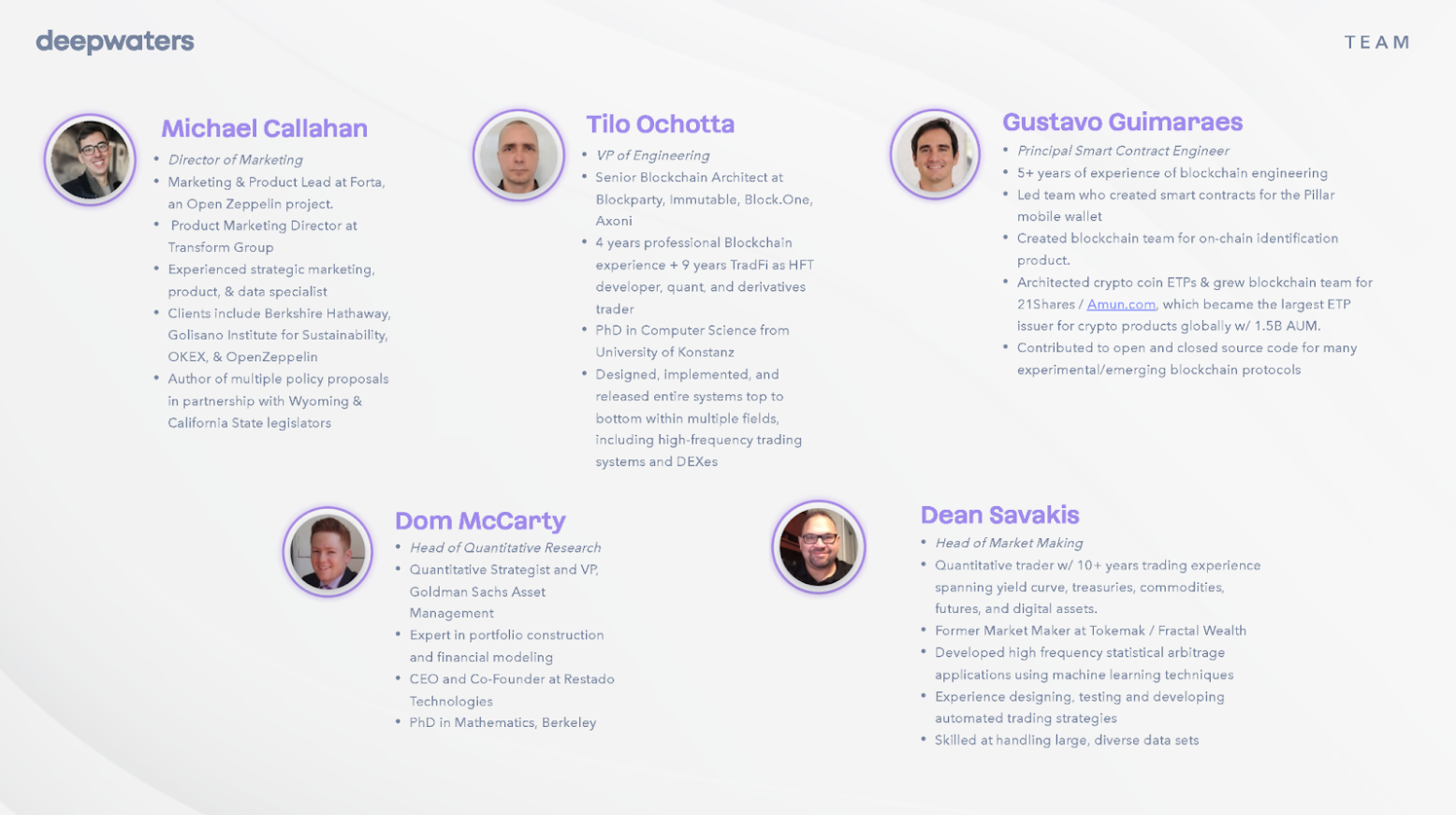
Deepwaters—Links & Team
Website | Telegram (Discussion) | Twitter | Blog | Blog II | Discord | Github
Partners & Backers
“IVC is proud to back Deepwaters, which aims to transform the way centralized finance operates by incorporating principles of DeFi into CeFi, providing traders with the first centralized exchange that is provably fair and secure.
With its hybrid architecture and real-time & decentralized platform validation, Deepwaters guarantees equal opportunities for all traders and upholds the necessary efficiency and compliance for the greater adoption of DeFi technology.”
– Jeremy Hsiao, Infinity Ventures Crypto (IVC)
“With Avalanche being the primary state layer for Deepwaters, Blizzard is extremely excited to support one of the most experienced and savvy teams in crypto.”
– Yi Hsin Wei, Blizzard Fund (VC arm of Avalanche)“Deepwaters team has a very professional team background to complete what they are trying to solve. The problems deepwaters trying to resolve are significant. They combine the best of centralized and decentralized platforms while adding novel functionality to provide a service which is highly efficient, compliant with regulations, yet trustless. We are very bullish on what they are doing.”
– Sona, LD Capital“We are one of the earliest investors that supported the Deepwaters team. We enjoyed working with the team for their deep expertise in building robust trading infrastructure, innovative ideas, willingness to take feedback, and ability to execute”
– Calvin Du, OP CryptoConclusion
The automated market maker represented a breakthrough in trading technologies. Quite swiftly, decentralized exchanges (“DEX”) were generating trading volume on par with their incumbent centralized counterparts but not without drawbacks. There has been nothing in the decentralized world where speed did not play a factor, where technology could not be used to game the system and certainly, nothing resembling a virtuous hybrid that offers an institutional grade self-custodied exchange.
Lowered barriers to entry, inclusiveness, disintermediation are some of the “true Norths” that blockchain has been founded upon and somehow, provably fair exchanges have not taken center stage. The maxim “move fast and break things,” has served crypto quite well but has also left some gaping holes in its wake.
Deepwaters is combining the ethos and trustlessness of DeFi with the efficiency, compliance, and throughput needed to ultimately bring this technology to TradFi.
The team at Deepwaters has deep experience across tech, fintech, and crypto/blockchain. Collectively, the team has had multiple large, public exits, conducted over 10 ICOs (including Reg A and Reg D exempt tokenized securities), built high-frequency trading systems, architected cryptocurrency-based exchange-traded products, and founded and scaled many companies prior to founding Deepwaters. There are 16 full-time, non-anonymous team members, including 3 PhDs.
The beta version of Deepwaters is going live on January 31.
“If I could summarize the Avalaunch team in a few words, it would be ‘integrity and competence’. We greatly appreciate that the Avalaunch team only puts forward projects that they themselves believe in. Avalaunch team was thorough in trying to understand our token, technology and intent. Their deep understanding of Deepwaters tokenomics resulted in a wealth of helpful advice, particularly about protecting retail post launch, a major concern of ours. Deepwaters mission is that of creating a level playing field. We want the general public to have the same opportunity as everyone else. This was the common ground for us. The Avalaunch team cares about their community. For them, running a launchpad is about passion for the crypto sector and love of the Avalanche community. That resonates well with us. Of course, they’re also just all-around great people. It was a real pleasure working with Avalaunch, every step of the way.”
– Zorrik Voldman, CEO / co-Founder
Token Economics
The WTR token (pronounced “water token”) is a utility and governance token for the Deepwaters ecosystem. WTR is accepted for goods and services provided by Deepwaters. It also provides coordination mechanisms for future development and various system parameters. While WTR is not explicitly required to use Deepwaters, it will provide the user with exclusive benefits, improving and expanding the user’s overall experience while allowing them to take part in the evolution of the ecosystem through governance.
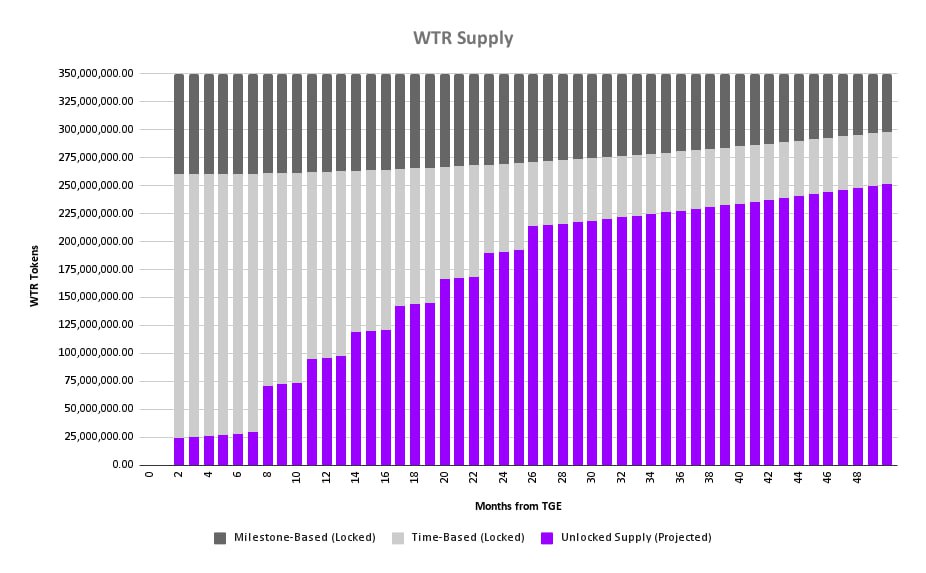
The total maximum supply of WTR is capped at 350,000,000 units (350 Million units). Issuance is both milestone-based and time-based. This is an effort to ensure that token distribution is commensurate with success of the platform and distributed over time.
WTR can be spent on various goods and services provided by Deepwaters. Some examples include:
- Trading fees
- Purchasing Deepwaters Memberships / Subscriptions
- Deepwaters premium data
Fees are denominated in relevant assets, corresponding to the user’s actions. WTR can be used to pay a portion of the fees on Deepwaters at a fixed dollar-denominated exchange rate of $0.70. The allowable portion is a protocol-defined parameter, subject to the user’s current subscription and/or recent trading volume.
A relevant example:
- User Alice executes a trade, selling 10 ETH for a price of 2000 USDC/ETH
- Alice pays a fee of 10 bps: 20000 USDC x 0.001 = 20 USDC:
- 50% of the fee is paid in USDC (10 USDC)
- 50% of the fee is paid in WTR at 1 WTR/$0.70 USD (~14.29 WTR)
Allocation and Distribution
Distribution of tokens is designed to promote a fair and diverse set of token holders, as shown below. By enabling all stakeholders to participate in governance and token utility, the system is set up with checks and balances ensuring the best interests of the project are pursued.
Funding Numbers
- Total Supply: 350M WTR
- Pre-Seed, tier 1 (4c): 16,866,250.00 WTR | 4.82%
- Pre-Seed, tier 2 (6c): 4,291,666.67 WTR / 1.23%
- Bridge (8c): 25,665,000 WTR | 7.33%
- Seed Round (12c): 25,000,000 WTR | 7.14%
- Avalaunch IDO (12c): 2,083,333.33 WTR | .59%
Total raise: $5.41M
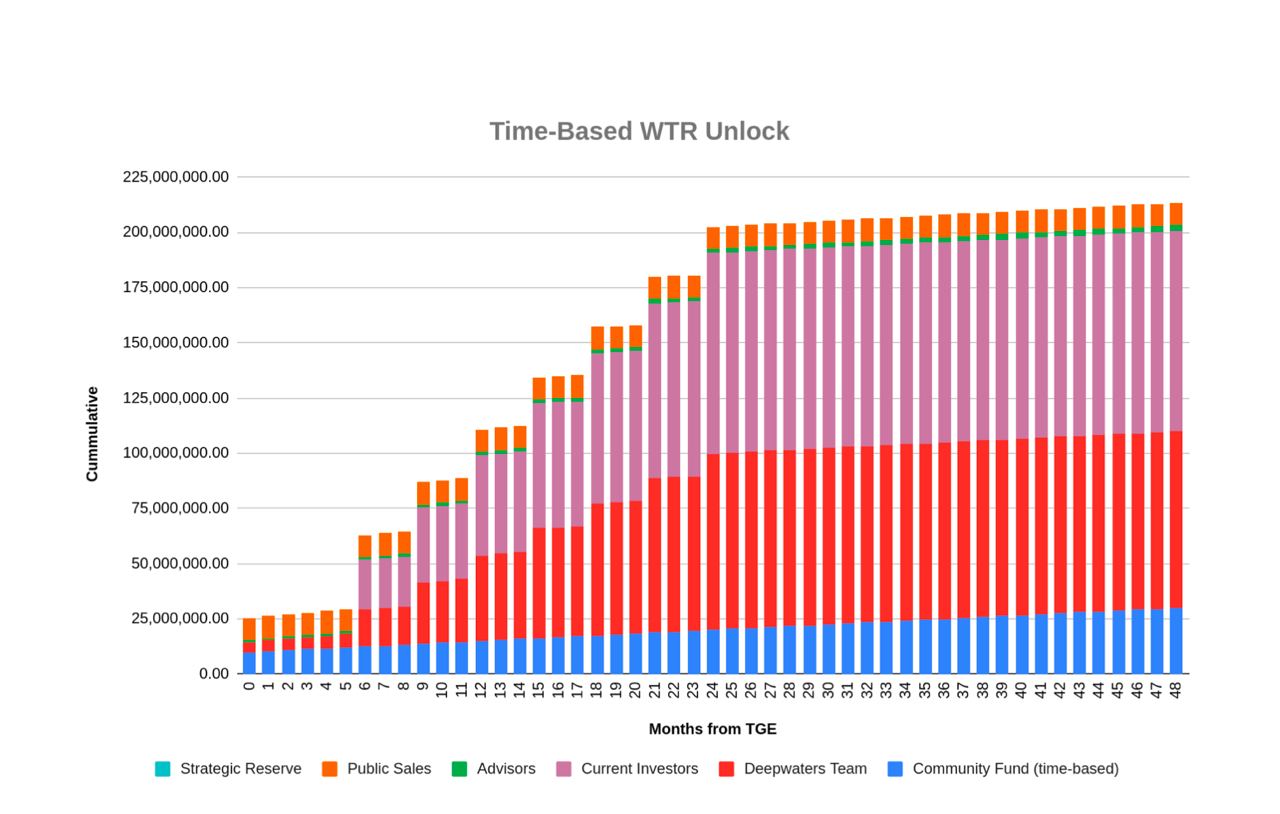
Project Tokenomics & Vesting
- Total Tokens (fully diluted): 350,000,000.00 WTR | 100.00%
- Deepwaters Team: 80,000,000.00 WTR | 22.86%
- Strategic Reserve: 63,192,083.34 WTR | 18.05%
- Pre-Seed tier 1: 16,866,250.00 WTR | 4.82%
- Pre-Seed tier 2: 4,291,666.67 WTR | 1.23%
- Bridge: 25,650,000.00 WTR | 7.33%
- Seed Round*: 25,000,000 WTR | 7.14%
- Advisors: 5,000,000.00 WTR | 1.43%
- Validator Rewards: 30,000,000.00 WTR | 8.57%
- User Incentives: 30,000,000.00 WTR | 8.57%
- Community Fund (milestone-based unlock): 30,000,000.00 WTR | 8.57%
- Community Fund (time-based unlock): 30,000,000.00 WTR | 8.57%
- Avalaunch IDO: 2,083,333.33 WTR | 0.59%
- Marketing / Promotion: 7,916,666.67 WTR | 2.27%
Initial supply: 24,407,035.80 | 6.97%
*Seed round tokens may not be sold in their entirety. Remaining supply will be added to the future investors pool.
Vesting:
Deepwaters Team
- 88% of team allocation: 6-month cliff, quarterly distributions over a two-year period.
- 12% of team allocation: Set aside as ‘employee incentive pool;’ reserved for recruitment, retention, and bonuses—Discretionary unlock
Strategic Reserve
- Held by Deepwaters for purposes of liquidity, partnerships, future investors, etc. Can be used at the discretion of the company with the following restrictions:
- Cannot be reallocated to team or advisors
- Cannot be sold on the open market by Deepwaters
- Any sale or other disbursement of tokens must have at least a 6-month lockup / cliff (call options to market makers must be either 1) European or Bermudan style and have at least a 6-month period before they can be exercised, or 2) American style with the lowest strike price at least 100% above the then-current market price)
Pre-Seed, Bridge and Seed
- 6-month cliff, quarterly distributions from mainnet launch over two years.
Advisors
- Allocated for rewarding advisors to Deepwaters, but can remain unused or be allocated to further community programs.
- Vesting varies across advisory and roles.
- 708,290 WTR unlocked at TGE
- Projected 1,443,970 WTR unlocked at 1 year past TGE (unless new advisors are added and given token allocations)
- Projected 1,958,210 WTR unlocked at 2 years past TGE (unless new advisors are added and given token allocations)
Validator Rewards, User Incentives and Community Funds
- These rewards are earmarked for Deepwaters users and validators.
- Validator Rewards — Awarded to validators for ensuring security of Deepwaters. Milestone-based unlock.
- User Incentives — Awarded to users to incentivize ecosystem growth and early adoption. Milestone-based unlock.
- Community Fund (milestone)— Strategic reserve controlled by WTR governance: to be used for community incentive programs. Milestone-based unlock.
- Community Fund (time) — These time-based rewards represent the strategic reserve controlled by WTR governance—to be used for community incentive programs.
- Unlocked monthly over 4 years, starting at platform launch
Avalaunch Sale
- 50% at TGE, 50% in one month.
Marketing / Promotion
- Allocated for promotional purposes, including airdrops. No lockup.
Other:
- Initial Circulating Supply: ~24.40M WTR (excluding liquidity tokens)
- Initial Market Cap: ~2.929M USD (excluding liquidity tokens)
The Deepwaters IDO on Avalaunch:
- Total Supply: 350M WTR
- 2083333.33 WTR at USD 0.12
- Sale Size: 250,000 USD
Registration Schedule:
Registration Opens: February 6th at 3:00 p.m. (UTC)
Registration Closes: February 13rd at 6:00 p.m. (UTC)Sale Schedule:
Validator Round Begins: February 15th at 6:00 a.m. (UTC)
Validator Round Closes: February 15th at 3:00 p.m. (UTC)Staking Round Begins: February 15th at 3:30 p.m. (UTC)
Staking Round Closes: February 16th at 6:00 a.m. (UTC)Booster Round Begins: February 16th at 6:00 a.m. (UTC)
Booster Round Closes: February 16th at 10:30 a.m. (UTC)
-
The BFG Roadmap

This article was written by Battle For Giostone Co-Founder Mile Gramatikov.
A Road Ahead
As a founder, sometimes a great idea will come, and you won’t be able to stop thinking about it. That’s what happened with Battle For Giostone.
After competing and building friendships in the MOBA space for more than a decade, we started to tinker with blockchain apps and immediately fell in love. The thought of combining the two became a mesmerizing concept — we couldn’t help wonder what the result would be of bringing these worlds together. Battle For Giostone is our attempt to reinvent gaming by allowing gamers to immerse themselves in familiar and fun experiences, with the added benefits of ownership and self sovereignty that Web3 technology provides.
That’s no easy task. But Gandalf the White said it best: “Things are now in motion that cannot be undone.”
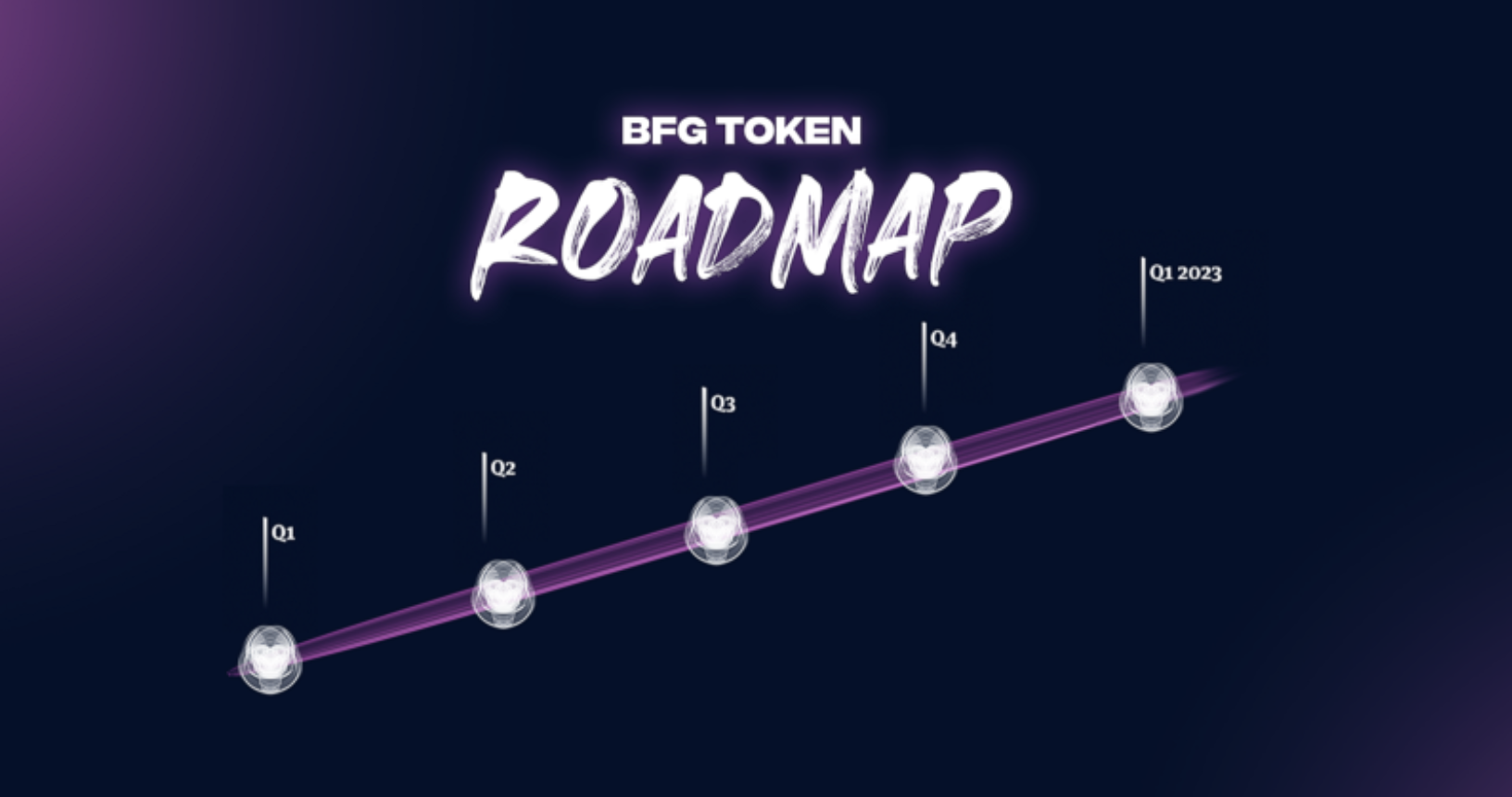
The Beginning — Q1 2022
Many people remember the beginning of 2022 as a time when the pandemic was still raging on in the world, and the conflict between Russia and Ukraine was heating up. In the Battle For Giostone offices, we were hard at work developing a product market fit for our idea. With the assistance of Theeban, aka 1437, we went through a couple of iterations of the game, conceptualized numerous new abilities, and crafted the first edition of our website. It was was rudimentary, but it was enough to test out the waters and we discovered massive community support for a Web3 MOBA game.
As soon as we had evidence that real players as well as professional gamers loved what we were doing, we doubled down on our ideas and started developing the BFG token. The tokenomics went under heavy development, and in the meantime, we started to develop out our early Web3 contracts (such as staking).
The game production phase itself also started in Q1, where we worked tirelessly to make the first edition playable as soon as possible.
The Middle — Q2 2022
The closed MVP game launch happened in Q2 2022. We devoted a lot of resources to developing the product, and it was important to us to have the hero and ability mechanics working the way we intended. Our initial idea was to make the fundamentals work, and then to make it beautiful later. That was our engineering approach, and it has turned out great. The parameters of the heroes and the abilities began meshing, but of course there were still a lot of bugs to resolve. One by one, we handled them all, ensuring that the Pre-Alpha would come out on time.
Q2 was also special because that’s when we launched our Forum. The Forum has been a place for the community to can discuss major events, patch notes, read announcements, talk about the economy, submit ideas about balancing the game, give item suggestions, or even talk about the rest of the MOBA world.
Also during this period, we were focused on getting Seed Round funding and pitching our idea.
The Current State — Q3 2022
Over the last three months, we’ve completely redesigned our website. That was a massive draw for our community because they loved the new look when we launched it. We also rewarded the most active participants in our Discord community with access to the Pre-Alpha version of the game and got enthusiastic as well as honest feedback from players about what they wanted to see next.
Turning this feedback into reality, we returned to the drawing board, covered their requests in new patches, and even started developing a surprise. This turned out to be our first hosted tournament, with the Pre-Alpha version of the game. Things were getting serious. After two successful tournaments, we started preparing for the IDO, scheduled for the 4th of October.
After the IDO is finished, we’ll start hosting monthly or bi-weekly tournaments with a Spectator mode that will allow casters to comment on what’s happening during the match in real time. That will elevate the streaming experience and transform the game into an enjoyable experience for players and spectators alike.
During this time, we also launched our Official Cinematic Trailer, released Pre-Alpha gameplay videos on YouTube, and released a developer update to cover the new designs and gameplay mechanics.
In the last several weeks, we have started publishing the Battle For Giostone lore. People can now go to our website and read about the story of the Three Kings, the appearance of the Giostone, what it did to their civilization, and why the battle started in the first place.
The Future — Q4 2022
We are really excited about what is to come. Once we complete the IDO, we will release information about the Closed Pre-Alpha game launch. We will also release the GIOS utility token, which will serve as an in-game currency and will not be a blockchain-based asset.
We will then release a marketplace and an NFT Heroes pre-sale and complete a CoinMarketCap listing. Immediately after our token generation event, we will create a liquidity pool where people can stake their BFG tokens and receive rewards for supporting the project early on, per our vesting schedule.
We will also begin placing a much larger emphasis on the Esports component of Battle For Giostone. We’re currently in the final stages of negotiating with several sponsors that we think will make our Tournaments legendary in regards to player rewards. We want the watching experience to be spectacular, where the Story Mode will help gamers immerse themselves into the heroes’ backstories and the world’s beginning.
Finally, we will begin working on the Android, iOS, and Ubuntu releases of the game to broaden our funnel for player onboarding. We are excited to involve as many people as possible in a project that aims to reinvent gaming as well as the rewards it provides for their time, effort, and skills!
-
BFG: Building A Token Economy
While progress is ultimately measured in both steps backwards as well as forward, those living in the day-to-day of crypto have an acute understanding of the pains of each step back. In the Web3, gaming is a microcosm of the broader markets and the embodiment of three steps forward, two steps back. While pundits nearly unanimously agree that blockchain built games will rule the roost in due course, getting there will not be without its growing pains.
There are complex difficulties in creating a sustainable token economy for a game. The current cris de coeur amongst experts is to shout the rather self-evident, “a game must be playable.” True, but there is much more to it.
We all know:
- Attracting users through inflation is unsustainable.
- Rewards easily earned are easily spent.
Typically, tokens can be earned through play, staking and LP’ing.
From first principles we can understand — a game is an attention economy. This is why the narrative “games need to be playable” is an important one. Should a DeFi protocol masquerade as a game, the attention required to drive sustainable ongoing growth is not there. Instead, participants merely work on “gaming” the protocol, rather than have the protocol serve the gaming experience.
Earning
The stain of an earning game that no longer has sustainable economic activity does not come out in the wash. Whilst Web3 games can be dynamic and create opportunities for a higher percentage of players to earn income—thanks to decentralized value distribution models—without ongoing revenue this model will fall flat. Dota2 famously generates more than 200M USD annually and puts about 40M of that revenue into tournaments. Were a Web3 game to attain similar success, by all accounts the tokenomics should be much more inclusive. This would equate to a much larger percentage of value being distributed via rewards, tournaments, tokenized incentives and the litany of possibilities that simply do not exist in Web2. However, the key differentiator here is that players return to Dota2 over the course of weeks, months and years. Utility (or attention) drives value, hence value needs to be driven into utility. Passive staking for example is not complementary to play and must be reconsidered. Game loops must be thought of as value loops, driven by the attention and enjoyment of the player.
A Word on Staking
Locking tokens to receive emissions is mildly worthwhile as it incentivizes vesting as a project matures but — it is not the utility of a token. Users receive more of a risky asset and can now mitigate some of the risk by selling it. This is a simple equation that often undermines inchoate game ecosystems.
Liquidity
Incentivizing liquidity is of value but should not be too heavily front-loaded or bloated, otherwise, users will depart when they see their outsized APYs dwindle. Teams should be willing to provide more liquidity than they often do for myriad reasons. Should a team not feel like their listing price is a worthy buy, why should anyone else?
Proper liquidity forces teams to reevaluate their diluted market cap as reliance on people showing up to provide liquidity for them in uncertain markets is a perilous prospect. Even in better conditions, the same scenario has played out ad nauseum — highly valuated, well capitalized projects experience a dramatic drop in volume, making it near impossible to enter or exit a position without massive slippage. While all markets have suffered greatly, these projects are going to have difficulty re-emerging as unlocks continue and every bounce gets sold. Teams that experience this become gun-shy and attempt to save every last dollar rather than defend their own token. The psychological impact is awful on early stage projects while private investors sit on the sidelines, saying nothing and waiting to sell. Early on, it is essential that a team understands their fragility as a new entrant into a highly volatile trading environment and must learn to balance their funding needs and liquidity.
Diluted Valuations
Battle For Giostone has a considerably lower diluted cap than most projects coming to market. And, as anyone can see, their distribution is a little different than what has become a standard but hugely flawed practice. Participants became worried that investors could own too much of a given supply and teams responded by raising their valuations in order to sell less tokens. This hugely limits upside potential and makes it extraordinarily expensive to provide liquidity, especially following unlocks. BFG as a project wishes for broad distribution of their token across their user base while conversely, keeping their cap table incredibly small. They have been remarkably efficient and believe that a lower starting point in terms of diluted value supports not only their prospective public but the future of the game economy itself.
This is inherent to preparing a worthwhile token economy — one in which the game tokens are prepared to grow in step with the growth of the game, not one where a newly released ecosystem sags under the weight of initial overvaluation.
In-Game Economy
The Battle For Giostone economy is a rethinking and gamification of the typical play-to-earn model. Sustainability should come from activity within the network and not be a slave to time-based emissions or investor demands. The borderline delusional hope that value can be shared and sustained through gratuitous emissions, without real underlying attention and activity will hopefully constitute a misguided footnote in Web3 gaming history. DeFi apps, which deployed similarly disastrous strategies, have woken up from the slumber of three-digit APYs to a rather stark reality. In recent months, the term “real yield” has become popularized. This simply means that APY is created by revenues derived from a given protocol. Gaming can be approached similarly even though the value of play is not something that can be perfectly quantified.
The dynamism of a token within a game is essential. While there is no game without capital contributions, players everywhere see these parties as prospective enemies. This largely adversarial relationship is problematic and was previously mitigated by very large community funds where players received free tokens, causing massive sell-offs. An improved appearance created a worse reality whereby the “cure” was worse than the “disease.” Tokens and their economy must be designed to serve both of these parties — the holder and the player — at the same time.
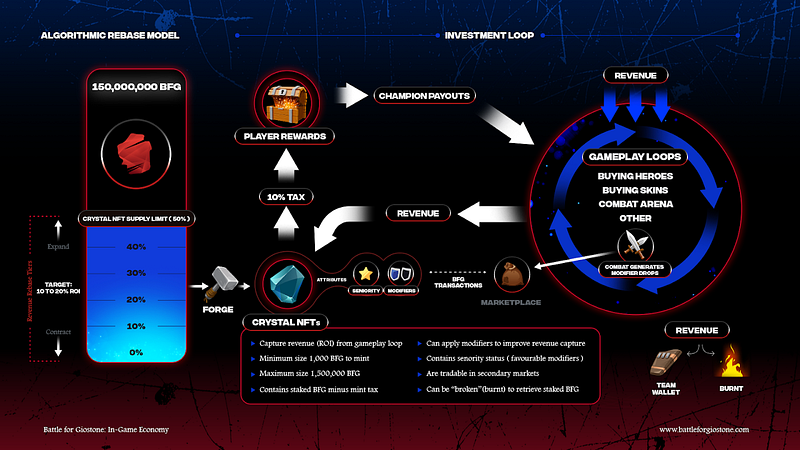
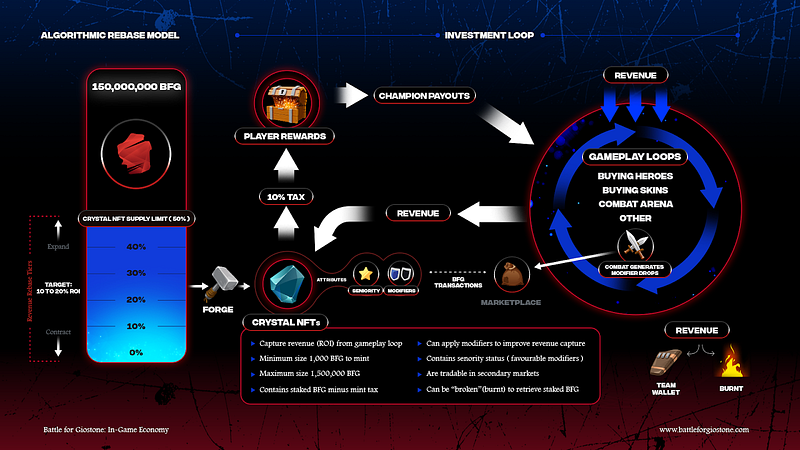
To better align incentives, the BFG economy has been designed to respect all types of token holders by introducing a looped economic system. After all, those who earn tokens bring activity and revenue to buyers while token holders can bring revenue to gamers, within the constructs of a mutually beneficial architecture.
A schematic of the BFG in-game economy (some of these values may change)
The diagram above illustrates how a shared value economy can function within both a gameplay and holder loop.
For example:
- A capital contributor who supports the project will hope to earn additional tokens by staking their tokens.
- In order to do this, they must forge an NFT which will be taxed.
- In the diagram, the tax is 10% (as an example).
- This tax is then deposited into a player reward fund.
This is the beginning of a symbiotic relationship — holders are likely to lock up their tokens when they see future growth potential in the ecosystem while future growth potential must come in the form of new players.
- Network generated revenues offer BFG rewards to the NFT stakers.
A Tradable Asset
An overlooked element in all of this is the listed token which can live in a world that is separated from the game itself. Since the BFG token utilities is an acting currency among other utility, all game associated revenues will be converted to BFG. This allows for some token velocity and creates a direct relationship between APY, token price and emissions.
- When the APY is lower, the token price will respond in kind thus:
- Stabilizing the amount of BFG tokens to be distributed as revenue.
- When rewards increase, APY increases as will the token price, thus:
- Stabilizing the amount of BFG tokens to be distributed as revenue.
- Any inefficiency or lag creates opportunity for those who follow the game’s economy.
There are additional safeguards in place that further capitalize on the price to earning ratio:
- Not all locked BFG will have earning power — it will be capped by a percentage of the supply to incentivize early participants to gain earning seniority.
Naturally, economic activity will ebb and flow but the APY will be adjusted at the both high and low end to best support a burgeoning economy:
- Effectively rebasing to a lower APY when activity spikes around very bullish price activity balances value between the token and its return.
- Conversely, boosting APY during a lagging or developmentally intensive period will also impact price.
- The overall effect is stability both in BFG earning power as well as potential token price.
The ultimate aim is to create a popular game that has a sustainable economy with robust token utility. This requires thought surrounding the speculative nature of crypto in general as well as the seasonal aspects of gaming. Three digit APYs do not support the long-term growth and reward a minimum number of early entrants. APYs that offer very little do not attract users. Using a rebase function to create ceilings and floors provides economic sustainability. This is also the reason that not all BFG will have earning power from day one. The reasons are as follows:
- A new game needs time to grow and creating seniority incentivizes early adopters to forge NFTs (lock BFG) in anticipation of network activity.
- Increased economic activity will create more earning NFTs but — it must be sustainable.
- A user can lock in their earning power by being early to forge an NFT.
Modifiers
In order to create a sympathetic relationship between active players and token holders there must be a point of convergence. When there is zero overlap between these two parties, dissent can occur as gamers tend to see capital contributors as a necessary evil at best. The reality is far different but in gaming economies, there is something of a Chinese Wall between token holders and players. One never seems clear what the other incentives are and on occasion, they function independently of each other. There are examples of games with poor token utility with limited activity and vibrant gaming communities. This is a massive lost opportunity for genuine synergy as a vibrant Web3 game needs players and speculators alike.
To combat this, Battle For Giostone has introduced artifacts generated from in-game activity that are of benefit to token-holders, called modifiers.
- Modifiers are NFTs that boost earning power for a finite period of time.
- Modifiers can only be earned through gameplay via random or skill-based drops.
- Token holders purchase these from players on the BFG marketplace.
- Modifiers can have varied utility but can only be used with forged NFTs that have earning power.
Mutual support between gamers and passive token holders is an ideal for Battle For Giostone. This is achieved through the dispensation of earning modifiers that are dropped to gamers as a result of general gameplay activity. The range of modifier functions will be broad, not limited to but including — improved APY characteristics for the modifier holder, upgraded seniority position in the locking queue, time-based upgrades that provide powerful results for a limited period, and rare modifiers that will only ever exist on a very limited basis.
Recap
The BFG token economy is a significant departure from what has become a flawed standard play-to-earn economy. In fact, there are numerous differentiators across gaming economies on the whole that represent an important step forward.
Some key features of the BFG economic cycle:
- NFTs must be forged by BFG holders and staked in order to participate in the rewards schema.
- Saleable items, of value to holders, are generated through economic activity within the game.
- Forging NFTs exercises a tax, generating rewards for the players.
- Yield is non-inflationary and tied to actual in-game popularity.
- Player Rewards tend to be earned by highly skilled players.
Within this gameplay loop, there is a token flow to players that is bolstered by modifier drops (which boost the earning power of BFG locked NFTs), to be sold in the secondary marketplace. BFG producing NFTs are seniority based so longer-term users are always first to earn. Depending on the flow of rewards coming into the system, an NFTs earning power will vary.
As it stands, there is a second tokenized asset, GIOS, which lives off-chain where players can only earn GIOS through gameplay and which will not be tradable on exchanges. It acts as an in-game credit and its primary purpose is to forge new Heroes. While there may be a modest conversion rate to BFG, the rate will be purposefully high to stimulate players to forge new heroes.
The game itself will evolve rapidly as assets are created and seasonal play begins. There will be clear epochs that will stimulate economic activity and create favorable circumstances for entry. New entrants into the game will not feel behind in any capacity and the entree itself can be sped up through skilled play or subsidized by economic activity.
Conclusion
The BFG economy is designed for any and everyone to enjoy, however, participation trophies won’t come with monetary rewards. The promise of Web3 gaming and broader distribution of value is that more players are able to economically benefit from playing a game but more does not mean all. It is unrealistic to expect things to be any different and the performance of early play-to-earn models are proving this point in a painful way. Nonetheless, they are not to be maligned as progress is always marked by those who came first and dared to experiment.
Battle For Giostone has set out to improve upon the great experiments that have come before them, focusing on creating an economic loop that seeks to unite the passive and the active, the player and the invested holder if you will. It is not a DeFi protocol dressed up as a game. It is a well-balanced game, a long time in the making, where yield is non-inflationary and rewards benefit all parties. Economic activity and play are the drivers of this economy, not inflation and bloated APYs. Investors are incentivized to forge NFTs that add to the player reward fund, and invest in boosting modifiers via the secondary marketplace to improve their yields. The ultimate motivation behind this design is to enhance the existing gameplay experience for players into something that is uniquely Web3 oriented, financially rewarding, whilst at the same time provides for the familiar sense of enjoyment found in traditional gameplay experiences.
-
Battle for Giostone AMA #2 (Recap)
On 10/01/2022 at 2:00 p.m. (PST), an AMA session was held on Avalaunch Telegram with Battle for Giostone Co-Founder, Mile Gramatikov. The focus of this AMA will be the business development, vision, road map, and post-IDO plans.
Below we present to you an excerpt from AMA with questions and answers.
Dave | Avalaunch
Hello again and welcome everyone to, not the first, but the second AMA with the venerable Battle For Giostone. They are a game with big plans and have an assembled a team they feel is up to the challenge.
Today we have none other than @milegramatikov ready to take on all comers and answer all questions. @milegramatikov how are you doing?
Mile Gramatikov | Giostone
Hey, I’m feeling awesome. Thanks for inviting me!
Dave | Avalaunch
Good to have you here today. Let’s get right into it…
Let’s start with a brief introduction about yourself: your background, career path, and how did you end up where you are today?
Mile Gramatikov | Giostone
First of all, I’d like to start with my background as a gamer. I played DotA when it came out, and I was instantly hooked. That was everything that I wanted to do in life. Then, Dota 2 came along, and it was even better. Because of my love for the game, I started connecting with other like-minded people, and that’s how I met most of my friends. We played the game in internet cafes, at home, and I even organized 20+ esports events related to Dota2. I was a massive enthusiast and competitive player.
When I finished high school, I completed a backend developer course and started working in a programming company. I worked as a backend developer for 2+ years and decided to switch to marketing. It’s a drastic jump from one niche to another, but something pushed me to try out marketing, and after 2 years of being a marketer, I started my own company. For the last 3 years, I’ve been the CEO of M-Tech Entertainment, and our company is responsible for handling the Discord security of the Axie Infinity server of Sky Mavis. That’s how I got into crypto, and an idea clicked into my head. That idea was Battle For Giostone.
Dave | Avalaunch
Well it’s safe to say you got off to an early start. Very impressive.
As the ultimate, first MOBA game, what’s the range of experience that the team holds collectively? How many in-house developers are working on the project? Are there future team expansion plans?
Mile Gramatikov | Giostone
Most of the team has been with me in M-Tech ever since the company came to life. Their skills have been battle-tested on numerous freelance projects that we completed. Even though we are based in Macedonia, we’ve worked with a myriad of international clients to gain the necessary skills and experience to make the peak of MOBA gaming.
Currently, 40+ developers and designers are working on the project. We’ve been steadily increasing the number of people that work with us. Since we’re about the launch the Closed Alpha of the game, we’ll push even harder. Of course, that means that the team will expand, and we’re always looking for passionate people to start working with us.
Of course, there’s also Theeban, our Co-Founder, who works as the game’s main balancer. His experience and know-how are irreplaceable since he’s the only person in the world to have so much Web2 and Web3 experience.
Dave | Avalaunch
That long history and working chemistry is a great thing to have when venturing into crypto. It will test all your relationships 😁
Battle of Giostone is a concept that was in development for over 1 year now. How many iterations did it take the team to prepare for the pre-alpha phase? Also are there any highlights about this major milestone you’d like to share with us?
Mile Gramatikov | Giostone
Many people think that making a game is easy. You just create a plan, follow it, and you end up with a product a year later. That’s not true at all. There are plenty of roadblocks along the way, especially when you’re dealing with complex game mechanics. Ten people will be clicking at the same time, and the program needs to respond to every click, every press of the button, combine video effects, and voice effects, and change the parameters of each character. All of that takes an inside amount of coding experience to make it work well together.
This explanation is to make it clearer for the people who think games are simple. At the moment, the Pre-Alpha is the 17th version of the game. The 18th version is on the way with a spectator mode that will allow us to host tournaments and cast them online. The first tournaments we made didn’t have this feature, so players needed to stream on Discord, and we broadcasted their streams on Twitch. We’re incredibly serious about esports, which is why we’re focusing on making the game work first, and then streaming it to the public to show what we’re building and how we’re progressing.
Dave | Avalaunch
I have news for you — after all that’s happened in Web3 gaming, no one thinks it’s easy any more.
As with most games built on the Web3, NFTs are intrinsic to this game dynamic. Can you give us a top-level overview of these NFTs?
Mile Gramatikov | Giostone
The main NFTs in Battle For Giostone will be the heroes. There are 6 hero combinations: Gogmangog, Auri, Akuma, Lucius, Ranvir, and Gurluk. Every NFT will have one of these heroes as the base, with equipment on their bodies. The equipment is responsible for the skills that each hero will be able to use inside the game, and you will not be able to change it. There will be skins that work like cosmetics upgrades, and they will only change how the hero or the equipment looks like, but they won’t be able to change the main design.
All of that was from the design aspect. When it comes to functionality, each NFT hero will have 4 ability slots. You can pick 4 out of the 72 abilities in total and forge a hero based on your play style. That could be a Melee Warrior, Ranged Warrior, Melee Assassin, Ranged Assassin, Melee Wizard, and Ranged Wizard. By matching the hero class and the ability class, you could create a tank, assassin, jungler, mage, support, fighter, or marksman. The style of play depends on you alone, as well as your team. More than 6 million hero combinations are possible, making the game incredibly competitive, and you’ll always be looking for the ideal champion.
Apart from the heroes, there will be skin NFTs that work like cosmetics for the heroes and abilities and revenue-sharing NFTs that allow you to lock BFG tokens.
Dave | Avalaunch
The heroes do look cool. Ranvir reminds me of a guy I know. Appreciate the comprehensive answers.
According to the roadmap, the plan is to hold an NFT pre-sale shortly after the token launch. Are you able to elaborate on this plan, how many NFTs will be available, the price range, and where the pre-sale will take place?
Mile Gramatikov | Giostone
We haven’t decided about the final number of the Heroes that will be minted or their price yet. But what I can say is that every one of those NFT’s that will be on pre-sale will be called Genesis and will be very rare. They will be only obtainable through the pre-sale. Let’s say Auri with Golden Wings. Everyone else will have the normal wings but your hero will be with Golden wings because it’s Genesis. Later, people can sell those heroes for profit if they decide, because everyone wants to have different and cooler stuff than the others.
Dave | Avalaunch
Nicely answered. Among the range of cool features that come with the game is an NFT marketplace. Can you talk about its use and how its integration relates to the vision of the project?
Mile Gramatikov | Giostone
I remember when I was little, my friends that played Metin2 or World of Warcraft were making money by selling accounts on shady websites. The game companies that made these games didn’t allow trading, and people became creative and created platforms specifically designed for exchanging characters.
We believe that the essence of gaming is to give power back to gamers. That’s why we’re choosing the blockchain and making the marketplace on our own website. Everyone will be able to come and buy or sell heroes, skins, modifiers, and even revenue-sharing NFTs on our site. Instead of us selling pre-made heroes through a game shop, gamers will have the power to create new characters themselves and trade on an open market. We won’t set the prices, which will make the gamers in charge. That way, the game is truly made for the players.
Dave | Avalaunch
With each Hero it seems that the user is able to combine their preferred abilities to create a Hero in their vision. For the audience that’s not aware, can you please briefly tell us how this process works?
Mile Gramatikov | Giostone
Sure. In MOBA games, the playable character usually has 4 abilities that can be either passive or active. Passive abilities give a general boost in stats or work under specific conditions. Active abilities, on the other hand, need to be clicked to work. They deal damage, heal the character or the allies, provide shields, or crowd control the enemy such as stunning, silencing, or disarming.
Based on your gameplay style, you can create a hero NFT that has the abilities you want to play. You can forge a warrior that does magical damage with their abilities. You can forge an assassin that has healing abilities. However, picking abilities from the same class makes the hero stronger since it boosts the base stats such as strength, agility, or intelligence.
Because the game will be free to play, gamers will be able to try out several versions of heroes that we will provide an update on a weekly basis. That way, they can learn how the abilities work, and what they want to see in their own hero, and then choose to forge something of their own or buy a hero that someone else already made on the Marketplace.
Dave | Avalaunch
One of the main features that I think will be extremely popular among the players of Battle For Giostone is the Esports tournaments which according to the roadmap is around the corner. Can you give us a comprehensive outline of how this will kick-start; what the players are to expect when this feature becomes available in Q4 of 2022, what the prize pools will be etc?
Mile Gramatikov | Giostone
Security is a massive concern. Axie Infinity is the biggest game in the space, and yet they suffered a 600 million dollar breach.No one wants that to happen, but there are cybercriminals whose goal is to ruin the experience of other people. We’ve included several security mechanisms to ensure the same thing doesn’t happen to us.
One thing that we’re still working on is to have a manual review of bigger transactions to ensure they’re legitimate and not a hack. Additionally, every internet project is only as secure as the people working on it, which is why everyone on the team is using an antivirus program, a VPN, and we don’t click on any links or download files that are unsafe. Socially engineered attacks are on the rise, which is why we’re incredibly careful and constantly upskilling ourselves in terms of cybersecurity and the latest scam or phishing attacks.
Dave | Avalaunch
As a first of its kind Esports MOBA on Avalanche, what were some of the challenges encountered while building the game, and how did you circumvent these challenges?
Mile Gramatikov | Giostone
The biggest challenge is making a game that’s actually fun to play. When you’re playing a game, it’s always the little things that make you angry at the developer, such as pressing a button and the ability casting half a second later than when you clicked. The user end needs to be seamless, and for that to be possible, many components need to work together without breaking. We circumvented these challenges by working relentlessly and using bots to play the game to see where it breaks to fix it before we actually launch it to the public.
Dave | Avalaunch
What were the reasons behind choosing to build on the Avalanche blockchain over the other options?
Mile Gramatikov | Giostone
Avalanche is one of the fastest networks in the entire blockchain space. The people that work on this project are some of the greatest we’ve seen, and they’re true to their mission and vision. We’re a part of the Avalance Builders program, and they saw the potential in us, which is why they invested in Battle For Giostone. They’re one of the top growing platforms, have a big name without any incidents, and their working environment is incredible. Last but not least, we’re going to have a subchain, which makes this partnership even better!
Dave | Avalaunch
Before we move on one final question Sir
Are there any lasting thoughts you’d like to share with our community before concluding this AMA?
Mile Gramatikov | Giostone
Battle For Giostone is a game that aims to reward players for their time, effort, and skills. Our goal is for every person in the ecosystem to find their place. People from different backgrounds will join our universe, and we want to have something for everyone. If you’re a good player, you’ll climb the leaderboards and earn rewards. If you’ve got a few friends, you can try to be the best in the group. If you’ve been a massive player of MOBAs and want to come back to the space, there will be new friends waiting for you. If you’re lucky, you’ll get modifiers to sell to investors.
If you’re somebody who doesn’t know how to play the game, but you want to be a part of it, you will be able to lock your tokens in a revenue-sharing program. If you’re a creator, you will be able to create content, build a community of your own, and get rewarded for being a part of our ecosystem. The opportunities are endless, but for all of this to work, the game needs to be fun to play. With the people we have at the moment, we’re sure that we can deliver. Stay tuned and see how we reinvent gaming!
Dave | Avalaunch
Congratulations Mile. You have fared in your journey through Avalaunch-land. Now you must stare down the twitterati, the forces that conspire to ask difficult questions. Are you ready for Part II?
Mile Gramatikov | Giostone
Yess!
Twitter Questions
@Xenada01 — How fast and secure is BFGiostone platform? If the number of users spikes, will transactions on your token get congested?
Mile Gramatikov | Giostone
We decided to work with Avalanche because their network is really fast and secure and offers great scalability solution with their Subnets. The ability to create your own rules on a subnet and use your token for gas fees is a great utility and it also provides instant finality. It’s an amazing opportunity.
@KleinVars — Many games today set high costs to start the game & therefore start with a small player base. Does Battle For Giostone only an entrance fee or starting conditions & if so,what are they?Do I need to hold an NFT or hold a certain amount of tokens in order to enjoy & play the game?
Mile Gramatikov | Giostone
Everyone will be able to play the game for free with one of our weekly free heroes. However, the free users will not be able to earn GIOS after each match but they can still reach leaderboards and earn BFG after each season.
We want to keep hero prices reasonable so the game is accessible for everyone.
@leonardo_mark11 — Which is the most proudest milestone BFGiostone has achieved so far?
Mile Gramatikov | Giostone
Having a balanced, cool and playable game!
Dave | Avalaunch
Great answer. Short, sweet and tells us everything. Well done.
@sentluciya — To what extent does your focus on the entertaining aspects of the game?
Mile Gramatikov | Giostone
The fun is based on complex gameplay, outplaying your opponents and collecting heroes & skins. Playing competitive for tournaments will be also fun and entertaining.
@Rozina_Kazin — There is a large audience that does not understand the English language at all but is interested in crypto. Have you created or planned to create local communities to include this audience in your project?
Mile Gramatikov | Giostone
We are working on creating local based communities, but everything should come at the right time and that is why we are not rushing with that. However, we have local communities in our discord and have separate chats for many different languages.
Dave | Avalaunch
Congratulations @milegramatikov you’ve navigated the treacherous waters of our questions and the inimitable peeps over on twitter.
Now comes the final leg of this great journey you’ve embarked on and that is the community. Normally we unmute the chat and allow it to populate with question but today we have a new twist. We have had our community weigh in…
Telegram Questions
@mrallaw — There are a lot of characters in the gameplay — what are they inspired from?
Mile Gramatikov | Giostone
Every character in the game is based on the lore which was created by our Art Director. Each character has their own backstory based on the lore. For everyone out there that wanna read the lore, you can do it at https://battleforgiostone.com/lore
@Ray699 — What are your plans for building a Subnet and how important do you think that is?
Mile Gramatikov | Giostone
Avalanche’s tech is generally superior to any other chain but subnets make it an easy decision. A sub-network with a strong set of validators is decentralized but it’s like having your own blockchain where you can make your own rules and function independently. Having your own token act as gas on the network is also a strong utility and encourages people to participate.
@birdie_johansen — Projects often overlook the utility of the tokens — can your tokens deliver value from the game?
Mile Gramatikov | Giostone
BFG is designed to do exactly that. Deliver value. It is the driver of all things in the ecosystem from gaming to passive holding. Transactions in the game translate to BFG. Rewards are in BFG. It is truly an apex token that all activity runs through. It is what makes the Web3 great.
The dynamic interface of a token with players is exciting, it’s just gotten so screwed up in the wave of games. A token that can earn rewards, be used as a currency, act as gas of a network, be bought and sold, used to purchase anything from skins to modifiers is so much more interesting than the web2 to me. It’s time to take advantage of that.
@naKohl1996 — What is the plan to ensure sufficient liquidity on exchanges to fill market orders, especially as adoption increases and clients begin multiplying year-over-year for your project?
Mile Gramatikov | Giostone
Listing liquidity is very important. Projects don’t consider this. When you have a token that has an FDV of say 40M and they put 200k in liquidity, it is basically .25% of the supply. That’s nothing and is not going to allow people to buy or sell without a lot of volatility. In a bull market no one notices. It all goes crazy.
We want people to discover us and be able to trade the token so our diluted cap is low so our liquidity could actually absorb what’s circulating. I wish we could buy the whole supply at IDO prices. Over time, the fundamental progress is what matters and then we will look to create more exposure for the token across exchanges.
Dave | Avalaunch
A tough but fair question. Mile was toiling. Fire answer though Sir.
and the final one is perhaps the toughest of all. Hope you’re ready for this —
@gksml1104 — As we saw with Axie’s downfall, the problem with current P2E is that it’s not sustainable. I believe that for a sustainable ecosystem, the focus should be on Play, not Earn. In this respect, I think BFG’s focus on esports is a good direction.
But can you really onboard a large number of players and host esports on a large scale? It seems that BFG’s backers are only Ava labs and Avalaunch, and there doesn’t seem to be any partnerships with YGG or other big gaming guilds.
If BFG has the capacity to host large-scale esports, why don’t VCs and gaming guilds approach BFG? Please tell me BFG’s vision for esports.
Mile Gramatikov | Giostone
This is a great question. To begin, I believe we can host on a large scale or I wouldn’t be here. Our background is in Web2 gaming on a professional level so we have strong ties to a number of large players in the space. We kept our cap table small for strategic reasons and you can’t get stronger investment partners than Avalabs and Avalaunch.
It’s like partnering with the whole ecosystem and we did not want to get into the VC game with 20 VCs on our cap table because this is a community project. We’re starting out with a very low market cap so people who learn about us can go for the ride. We weren’t going to sell it all to VCs and let them own it and play that game. As part of our rollout, we have been in touch with numerous guilds, both very large and more boutique.
Our vision for Esports and overall vision for the game has been spelled out in detail over the last few weeks. There are tons of videos and articles we put out with Avalaunch that are really worth having a look at. When people really see how devoted we are and the progress we’ve already made, they’re going to wish they paid more attention.
Dave | Avalaunch
Excellent work. That was a tough question. The last two especially.
Appreciate your time here today and your occasional presence in our chat. I appreciate you moving forward in these uncertain times and having the confidence in the game to drive things forward.
Mile Gramatikov | Giostone
It was great to be here, thanks for inviting me over. I hope that the community learned a lot from this AMA and if someone got more questions feel free to ask anything here
Dave | Avalaunch
Thanks again. Pleasure having you. Have a good weekend.
-
Building A Web3 MOBA
This article was written by Battle For Giostone Co-Founders, Mile Gramatikov and Theeban Siva.
Filled with promise, blockchain gaming has taken the world by storm and it has been stormy at times. In a space still taking its earliest steps, forging ahead requires development teams to navigate an oft confusing road. This is especially true in the creation of a Web3 MOBA.
MOBAs are the most difficult games to master because they exhibit infinite strategic complexity. To begin with, one must make team-oriented decisions — it’s as if instead of controlling the entire chessboard in chess, you control a single piece. And instead of individual defined moves, you must then make thousands of momentary decisions which build towards the same goal as your four other teammates. Popularized by Dota2, League of Legends, and hundreds of other copycat games — we believe it is now time to transition this Web2 genre into a true Web3 experience.
Battle For Giostone
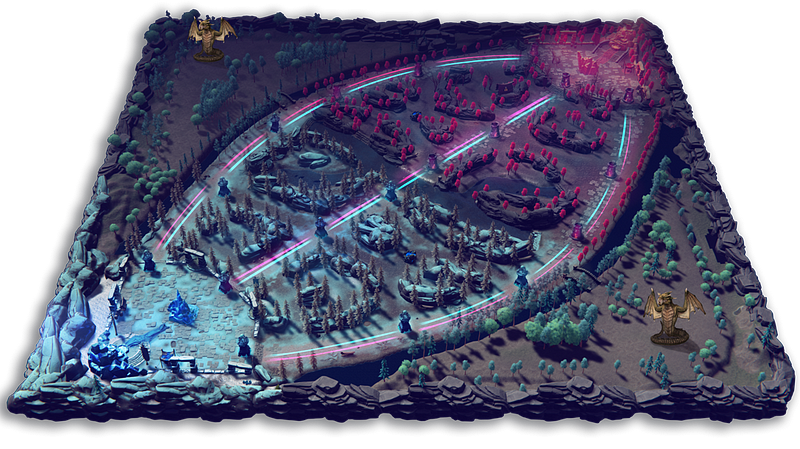
Battle For Giostone has already undergone significant active development and is coming up on an alpha release. From the outset, you’ve got two teams made up of five people, and the goal of the game is to destroy the enemy base within the first 25 minutes. This mechanic should feel very familiar to existing MOBA players.
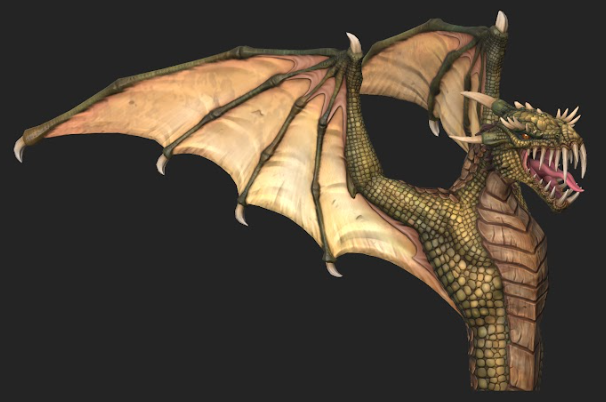
However, there is an added a gameplay twist. Should a base not be destroyed in the 25 minute time-frame, all of the players get summoned by the dragon Gio (a monster that spawns on the map, dropping stones to powerup teams following defeat), leading to a battle to the death. The winning team of this final fight emerges as victorious.
Uniquely, in Battle For Giostone, Heroes are created via a forging mechanism. Instead of using pre-made heroes, players are able to forge an ideal hero, customized to individual playing styles. There are six Hero classes and a total of 72 abilities, with each forged Hero possessing 4 permanent abilities. With more than 6 million combinations of play styles available, strategy and playing to one’s strengths is of paramount importance.
From the outset, we have wanted to make Battle For Giostone a game that was built by passionate MOBA gamers, with tweaks that we believe improve the overall gaming experience. This might sound easy in practice — but turning that into reality is another story. In Battle For Giostone, gameplay has always been our main focus. An example could be — if you attack an enemy hero and they’re near their creeps, they need to start attacking your hero to defend their position. We believe that continued refinements like this add up to an overall experience that takes the genre forward.
Visual Design
In order for a game to be successful in this day and age, it needs to be visually pleasing. This is obvious but surprisingly overlooked as gaming projects often prioritize the wrong things. In a MOBA, the map, towers, creeps, heroes, bushes, lanes, equipment, abilities, the dragon Gio, and the user interface need to have the same theme, branding, and look like a premium, AAA game. We have a team of designers working continuously to push out in-game assets whose aesthetic supports this vision.
Balancing
Abilities, stats, level upgrades, and items require lots of balance testing. Most abilities have counters, and the ones that don’t will be countered by items. Heroes that have abilities from the same class have increased stats, and that can influence the outcome of a match. Balancing means that all playstyles and levels of experience will feel rewarding in-game. Over time, this meta will change and we will remain vigilant not to nerf, or overpower specific abilities in those changes.
Tokenomics
Gameplay and design must be at the heart of every Web3 game—but that doesn’t mean that the tokenomics aspect isn’t a vital and crucial piece to the puzzle. Some people will play a game just because of its ability to earn. In Battle For Giostone, there are two tokens: BFG and GIOS. BFG is a blockchain-based token on the Avalanche network, while GIOS is a non-blockchain token that will work as in-game credits to forge heroes. BFG is the absolute driver as we don’t believe utility belongs in the hands of a team controlled token supply. It is there to complement BFG and allow users to advance in the game while BFG runs and effectively is the economy. We are constantly refining our design around these tokens to ensure that rewards will be fair for both the players and the investors.
Players will be able to earn by playing, winning esports events, forging, trading Heroes, and creating content. The more passive will be able to earn by staking BFG tokens but must forge NFTs to receive any share of the revenue from the game and furthermore, need players to maximize their earning potential. In order to increase staking rewards, token holders require modifiers that spawn inside the game, and must buy them from the players. This creates a circular economy and a closed loop where the two sides help fulfill each other’s objectives.
Community
The best game in the world, is nothing without its players. Our community has been incredibly supportive so far, and we are excited to see it continue to grow. Many people have played traditional MOBA games, but are thirsty for something new. We believe Battle For Giostone is the thing they’ve been waiting for.
Team
Everyone on our team is passionate about MOBA gaming and crypto, and they firmly believe Battle For Giostone is the future of Web3 gaming experiences. We are a highly motivated pedigreed team filled with skilled individuals working toward the singular goal to make both the game and a token economy a riveting success.
Conclusion
While we don’t suffer from a lack of ambition, we are very grounded and focused on our deliverables. The Web3 may offer unlimited potential which has also hastened the migration of opportunists looking to exploit the space. Hyper inflationary tokenomics and unsustainable DeFi protocols masquerading as games are slowing the potential for growth and BFG believes it is incumbent upon us to do something about that—beginning with a game that earnest games want to play.
-
Battle for Giostone: Esports & Tournament Infrastructure
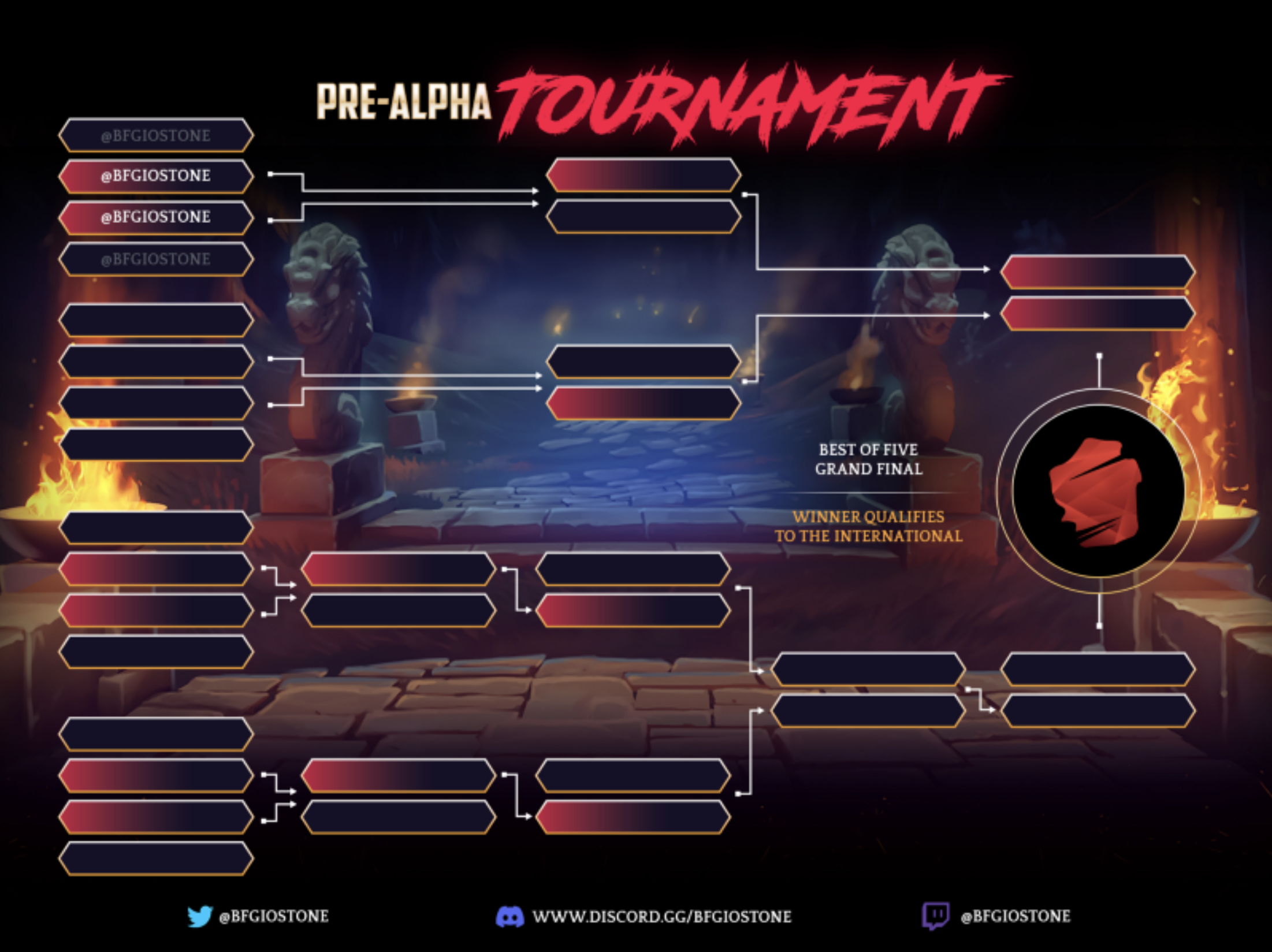

This article was written by Battle For Giostone Co-Founders, Mile Gramatikov and Theeban Siva.
Without question, play-to-earn made a massive impact on the entire crypto space with Axie Infinity paving the way. The sector grew quickly, perhaps too quickly as the infrastructure and inflationary tokenomics could not support such a large influx of playing and earning. Scalability issues and sell pressure were an inevitability that we are now facing.
Both opportunists and players came in droves and unceremoniously left. It was lacking in economic stability but from a player’s standpoint, there was a crucial missing piece of magic that has historically kept players hooked and that is tournaments.
Tournaments
Gaming is all about competition. The quest to climb the leaderboards and prove that you’re among the best in the world is an inherent driver for any true gamer. It may start passively enough as users hone their skills to be competitive with friends, and from there, morphing into an unquenchable desire to dominate your opponents. That’s true in chess, it’s true in checkers, and it’s true in any other game on the planet.
A MOBA, being the most complex game of all, requires the combined effort of five people to play as one. Unity in the name of a singular goal will push one team to victory, while the others will succumb to defeat.
As humans, we love watching competition when the stakes are high, and the boundaries of what we think is possible will be pushed. It is a vicarious thrill as we live in the moment of a shared experience with players and spectators alike.
“Winner take all” tournaments are the ultimate form of competition because there can only be one. It is an all-or-nothing proposition where only one team will be left standing to claim the grand prize.
Battle For Giostone—First Tournaments
Battle For Giostone is a game that’s embedded in true MOBA culture. We are defined by Esports and started hosting tournaments long before the pre-alpha was released.
Recently, two of our guild partners competed in the first tournament, and the gameplay was spirited and intense. It was a watershed moment for us and following this success, we allowed multiple guilds to compete in order to further crystallize our vision for the game.
In the beginning, the two opposing teams were targeting the enemy shrines. These structures restore HP and Mana which is crucial for team fights when you’re running low and battle beckons. The teams actively guarding these structures were initially able to slow the matches because no one wanted to lose their shrine. However, when multiple guilds joined in the second tournament, a massive shift happened to the in-game dynamics. The players understood the role of Gio and the Giostone giving powerups to their creeps. Suddenly, the gameplay changed, and everyone rushed to kill the dragon before the enemy team. The match duration decreased instantly, which led us to add another victory condition.
When players are unable destroy the enemy base within 25 minutes, they will be summoned by Gio for a team fight battle to the death. This is of paramount importance as the last team should always stare down and overcome death before they can exit as the winner.
Our Next Tournaments
Rome was not built in a day. Everything great requires time, trial, and error in order to continuously refine and improve the game. Our mission is to be recognized as one of the best MOBA games ever made. We can only achieve that by hosting sizable tournaments with significant prize pools, competitive viewership numbers, and partner collaborations.
Casters make tournaments special because they add their personality to the matches. Their commentary builds up the hype, and newbies and pros alike will have the same knowledge about what’s happening at the moment, what could happen, and what each team is thinking. These people will know the game inside and out.
Finally, if local communities, individual organizations, and creators would like to host a tournament of their own, we are open to creating unique maps, custom skins, and ad placements for them.
Let’s say that a massive sponsor wants to create an open tournament where everyone will be able to compete. We could make custom towers and creeps to thank them for their support or add their logo on the lanes or shrines. That way, apart from the leaderboards, the players would have an additional source of income that increases the total earning potential from the game.
Tournaments Are Filled With Emotions
People love games that make a visceral impact. Experiencing an emotion, a drive and desire is amplified when it is being experienced in real-time by any number of people. When thousands or even millions share an emotion, you get a masterpiece.
Recently, Theeban, aka 1437, visited our home country Macedonia. In a small local internet cafe, we played a few matches and felt an atmosphere of pure emotion. That’s what we want to achieve on a global scale. Happiness, sadness, anger, joy, rage, and elation unite people, crossing physical and language barriers.
Join us on our quest to reinvent gaming.
-
Avalaunch & BFG: Behind The Scenes
Supporting a new project is speculation at the earliest stage. Volatility is expected and only in the long run can we truly determine what constitutes success and failure. As so much of crypto is ever evolving, participants and projects alike must contend with changing times and wildly varying conditions.
For this reason among others, Avalaunch has increasingly looked for opportunities to engage with projects as early as possible, and help shape the balance between their needs and the sale design to drive fair value for its community. Avalaunch believes an “early incubation” approach is a key to long-term success and represents the best path towards decentralizing access to nascent value.
For example, valuations in crypto are susceptible to market cycles and high levels of institutional interest can mean that deals come pre-funded, where no single investment group is large enough to dictate the final terms of a sale. Despite having lasting relationships with all of our launch partners, Avalaunch has largely been exposed to initiatives where funding was secured, either in part or whole, and economies were designed with a stamp of approval by the project team as well as the investors responsible for funding the project. For every project, there is always a measure of input but ultimately, market conditions and committed interest remains the authority.
While this is still the norm, Avalaunch has been searching for a special team with similar value to be more hands on with. Battle For Giostone (“BFG”) is just that — a true tabula rasa for collaboration.
The Battle For Giostone Difference
To get right into it, Avalaunch has worked closely with BFG in order to:
- Offer a very competitive market cap where upside can come with the growth and economic activity of the game itself.
- Achieve a design for an imminently playable game
- Work with a team that has made a personal capital investment and is willing to defend their value.
- Launch a project with near-term milestones and catalysts.
- Create a small, curated cap table for the seed and private rounds.
- Acknowledge and reward Avalaunch Gold Stakers.
Design a sustainable token gaming economy that:
- Recognizes rewards must be earned and
- Requires players to demonstrate skill and mastery in order to profit from play.
These were some key fundamental considerations and the BFG team were very proactive in recognizing the importance of these crucial elements and have addressed them as priorities. The BFG team has:
- Personally seeded the project with 500K in capital.
- Has a combined two decades plus of professional gaming experience.
- Roots in Web2 multiplayer online battle arena (“MOBA”) games and rightly critical of Web3 efforts to date and is determined to vastly improve upon things.
- Founders — professional gamers, Axie Infinity world champion, owner and operator of a software development company native in crypto as well as Web2 gaming.
- Are ready to launch a closed alpha shortly following the TGE.
- Have partitioned out 60% of their seed round for Gold Stakers.
For Avalaunch, it has been a pleasure to work with the BFG team, and make joint decisions that can have a material impact on the future of the project and its supporters. The BFG team has been very proactive in recognizing the importance of these crucial elements and have addressed them as priorities.
As champions of the Avalanche ecosystem, Avalaunch has long strived to make a difference by creating awareness and visibility for the individuals and teams building here. Since inception, Avalaunch could be seen to have two primary goals — to support the growth of the Avalanche ecosystem, and deliver potential opportunities to our community. The nuances of achieving each are varied, the former requires amplifying awareness of projects and providing guidance in their decision-making, the latter means vetting and identifying core value components that must be realized to achieve long-term viability.
-
Battle for Giostone AMA #1 — Project Overview with Theeban Siva (Co-Founder)(Recap)
On 9/26/2022 at 2:00 p.m. (PST), an AMA session was held on Avalaunch Telegram with Battle for Giostone Co-Founder, Theeban Siva. The focus of this AMA will be the business development, vision, road map, and post-IDO plans.
Below we present to you an excerpt from AMA with questions and answers.
Dave | Avalaunch
Once again it’s on. Today is a special AMA for us.
And I’d like to welcome any and all who might be present to see a little science get dropped by none other than @theebansiva our resident Battle For Giostone co-founder and gamer extraordinaire.
@theebansiva welcome. how are you?
Ready to do this like we always knew this?
Theeban Siva | Giostone
Hey guys! Thank you for having me here, and I am ready!
Dave | Avalaunch
Excellente. Let’s kickstart this AMA session with a brief introduction about yourself. How did you get involved in crypto and how did the events transpire to your current position?
Theeban Siva | Giostone
Sure thing! I’m Theeban or otherwise known as 1437! I got into crypto when I retired from Dota 2 and decided to pick up Axie Infinity. I met Mile and the team through Axie and Dota 2 actually!
Dave | Avalaunch
A legit world champion Axie player and a pro gamer. I know you want to be modest but I’m free to brag about you.
How did the team come together, and what was the turning point to building the Battle of Giostone?
Theeban Siva | Giostone
The team is made out of people that have known each other for a long time, and have a couple of successful projects behind their back. The trust was already there because the core team has literally grown up together ever since they were kids, and they’ve upskilled and become better constantly. I feel like I was the missing piece, and I really felt that when I came to the office in Macedonia and they treated me like a part of their family. Virtual bonds form even stronger friendships, especially when you’re working on a vision that will unite gamers and rewards them for their time, effort, and skills.
Dave | Avalaunch
Yeah, this is a long time in the making.
Got it. Moving on — For our audience that are not yet aware, can you tell us a little bit more about the Battle for Giostone? What is it and how did the idea of creating this game come about?
Theeban Siva | Giostone
Battle for Giostone is a MOBA game. The style was inspired by Dota2 but the gameplay is different and unique compared to Dota and League of Legends alike. Our game uses uniquely forged heroes that can be tailored to the preference of the player. Unlike the other popular MOBA games right now, we have a secondary win condition apart from destroying the enemy’s base.
Dave | Avalaunch
As an Esports MOBA there are different ways of ensuring victory, based on each player, their skills, the dynamic between the team and so on. Can you give us a high-level overview of the game mechanics at play?
Theeban Siva | Giostone
The typical MOBA has a pretty basic victory condition. You need to make way to the enemy base and destroy it. You can use any strategy in the world to do that, and that’s the main objective. If both teams are evenly matched in Dota 2 for example, a game can last for an hour or more. Sometimes it can last 15 minutes, if there is a massive difference in skill or strategy. An hour is too long for a single match in our opinion, which is why we implemented something completely novel.
We wanted to take things a bit further. Instead of having a single victory condition, we added another one to ensure that all games are completed in 30 minutes max. So, players will have 25 minutes to destroy the enemy base. If they don’t do that by then, the dragon Gio summons all of them to a deathmatch field on the map, where they have to battle it out to the death.
That adds even more complexity to the game because some teams will want to wait out the entire match and wreck their opponents in the final battle. Others would want to finish things as quickly as possible. This adds incredible depth to the game since you won’t know what your opponent’s tactics are going to be.
Dave | Avalaunch
And this is one of the places where balancing must be quite a consideration. I know you’ve got your share of experience with that. — With several Web3 games already available on the blockchain, how does Battle of Giostone aim to remain competitive and increase its user base? What makes this game unique?
Theeban Siva | Giostone
The entire blockchain space has been thirsty for a MOBA game. On top of being a Free to Play game, the competitiveness makes it different from everything that’s already available on the market. The token is deflationary, the designs are going to look insane. The game is literally a bridge between the Web2 and Web3 worlds.
There are a lot of variables in the game and ways to get the custom hero that you want that only you may know how to pilot. This will be a game that will be unmatched in terms of uniqueness overall and even on a match to match basis. No two matches will be the same.
Last but not least, the game will be fun to play and watch, which is a breath of fresh air compared to some of the games that came to the space as pale copies of others or simply looking for a cash grab.
Dave | Avalaunch
This is true. MOBA’s absence to date is conspicuous. This is filling a need and I’m confident you all are more than capable of making it special.
The economy of the game is run by two tokens: BFG is the driver but also GIOS. Can you tell us what they are, how they differ and how they work to maintain the game ecosystem?
Theeban Siva | Giostone
The BFG token is the main currency of the game and players will be able to use it for pretty much everything in the gaming universe. First of all, players will need BFG to be able to buy Heroes. It will also be used for buying skins, Compendium purchases (similar to Battle Passes), as leaderboard rewards, and investors will lock up a quantity of BFG to participate in revenue sharing from inside the game.
GIOS on the other hand will function as in-game currency. Players that own NFT heroes will receive a few GIOS tokens after every victory and will be able to forge new heroes. That’s the primary purpose of the token. Of course, they could also be able to convert it to BFG, but the rates will be purposefully kept low to stimulate more forges.
Dave | Avalaunch
Gotcha. Good to see a single token really drive the ecosystem while GIOS lives off chain and is just there for hero forging. It makes more sense than most. For those wondering how do you strategize to maintain a stable price following the launch, what can you tell us about your plans to ensure a successful token launch and long-term price sustainability of the token?
Theeban Siva | Giostone
Since people have wanted a Web3 MOBA ever since the space started to exist, they see the long term potential of the game. Everyone knows we’re in a bear market, but the thing that makes or breaks a crypto game is the community and how fun the game is.
We believe that the people who invest in our token see the long term benefits that come from holding it, mainly because of the revenue sharing model.
Locking up your BFG tokens as an NFT makes it gain value and adds real utility. The NFT bubble popped a while ago, and nobody is going to invest in something that doesn’t have real utility. Since investors will be getting a percentage of the revenue all the time, there’s no selling pressure, and I think we’ll have a pretty stable launch with people holding their investments until the next bull cycle.
Dave | Avalaunch
Rock on. With arguably one of the strongest backers in the Avalanche ecosystem already secured, what are your plans for further strengthening The Battle of Giostone partner ecosystem? Are you working on any exciting collaborations you can tell us about?
Theeban Siva | Giostone
The Battle For Giostone ecosystem is strong at the moment, but of course, we’re still working on a few new potential collaborations. However, the thing that we’re most excited about are guild collaborations. The game is made by the players, and they’re the crucial component of the masterpiece we’re building.
Guilds like METAT8, Real Deal Guild, Mad Lads, and others are already playing the game, and we’ve got a massive Tournament with 16 teams already signed up in our Pre-Alpha mode. That’s 80 competitive players and many who support them that already love the game and want to play.
Dave | Avalaunch
Looking at the roadmap there’s a lot of interesting events lined up for the next few months following the launch, including the Heroes NFT pre-sale (which someone asked about earlier), launch of the marketplace, and of course the grand opening of Esports. Are you able to divulge any insights on any of these to our community right now?
Theeban Siva | Giostone
For the last part, as I mentioned before, we’re already making the grand opening of Esports competitions. We’re building with that as the foundation, and we think that hosting Tournaments before the final version of the game cements our place in the Web3 space as true visionaries of how progress needs to look like.
Of course, there are massive balancing changes at the moment, and the game is still under heavy development, but what we’re seeing from people is that they’re here for it. They want to be a part of the corrections and they want to see how the meta evolves to train for the real deal. There’s nothing better than that.
Dave | Avalaunch
Your experience in the Web2 esports space is invaluable, seeing how it all gets built out. Good work. Let’s move into the final part of this section with a few more basic questions. What is the long-term vision, the end goal of the Battle of Giostone?
Theeban Siva | Giostone
The long-term vision is to have a sustainable ecosystem where everyone can have fun and enjoy being a part of our community and game. In a way that’s also the end goal. The road will be bumpy but we believe we will make it happen.
Dave | Avalaunch
Looking to the future, what are you most excited about?
Theeban Siva | Giostone
Tournaments. Since I love competition and watching it, I’m looking forward to seeing what kind of competitors will be participating in our game. The talent and entertainment these players will be able to showcase with the amount of variables involved in our game will be unmatched. Our large scale tournaments are going to attract the best competitors and countless hours of entertainment.
Dave | Avalaunch
I should have been able to guess this answer. You and @milegramatikov have big plans here.
Now, before we move on to the twitter portion of your program, one final question. Are there any points you’d like to discuss or touch upon, or perhaps share with the Avalaunch community?
Theeban Siva | Giostone
One thing that I would like to mention is that the game is going to be made for PC first. We’re trying to get a handle of the mechanics as per our Roadmap, but a mobile version of the game will be in the works as soon as we finish building the initial one. So for everyone that’s waiting for the game to come out for mobile, they’re going to wait a while, but it’s going to be well worth it!
Dave | Avalaunch
You have fared well to this point Ser.
Twitter Questions
@AdcDavidtai1999 who asks — For the moba games, are you planning to hold some national competition?
Theeban Siva | Giostone
Yes, we will have many large scale events throughout the year. We are very much Esports focused and that is our main goal.
@chimponzi_jam — How might your Revenue Model assist both the investor and your project in a win-win situation?
Theeban Siva | Giostone
We can’t talk about the investor and the project without talking about the players. They are the foundation that the game will be built on, and we must keep a player-centric model to keep everyone satisfied. The investors bring in fresh capital to the game yes, but the players bring in the entertainment, which then brings in the sponsorships, which then rewards the investors too.
@sentluciya — What are your long term marketing plans and do you have any partnerships that you plan on utilizing?
Theeban Siva | Giostone
Marketing in the Web3 space is quite difficult because there were a lot of unfortunate events or scams that has happened in the past year. Think of what happened with the Squid Game token and all of the dog-like tokens that popped up out of nowhere. Our long-term marketing strategy is to make a fun game that people will enjoy playing.
There’s nothing better than organic growth, and if people are really having fun and immerse themselves into the matches and the gameplay, the marketing will come naturally. Of course, we’ve got a lot of partnerships with influences in the crypto sector to get the word out, but ultimately it will depend on the quality of the game and the happiness and emotions the game evokes in the players.
@cryptotrung — Before a great project comes to fruition, great inspiration must precede it. How did you get the inspiration for the project?
Theeban Siva | Giostone
First of all, we’ve been gamers our whole lives. I’ve played Dota2 for 15+ years, and Mile has been playing it for that long too, even though not professionally. He’s organized esports events in his own country, and when the Web3 space started becoming popular, we both felt that something was missing.
We both love MOBAs, that’s the type of game we’ve played for our entire lives, and there was nothing like it being built. We decided to take matters in our own hands and create the first authentic MOBA on the blockchain. That’s how the idea for Battle For Giostone was born, and now we’re turning it into reality.
Dave | Avalaunch
This is exceptionally important imo and great to see.
Now, moving on…As ringworn veteran of marathon games, you must know we are not finished with you yet. There’s a gauntlet that is yet to be run and that is none other than the community question. For this, our very own @shahi297 will unmute the chat for a few minutes, the chat will populate with questions and we will mute once more. At this point, you will choose your 5 faves and please directly link to the question when you answer because prizes are on the line.
Telegram Questions
Lucas — Do you guys feel satisfied by seeing your progresses and achievements till now, when you look back to the day when you have started this project?
Theeban Siva | Giostone
Sometimes I look back at our older builds and I am amazed by what our team has done in this time frame. It has been such a pleasure to work with such hard working individuals and I;m even more pleased to say that we have been ahead of schedule and our roadmap.
Melanie Dalton — IS your project only for elite investors, what about others with small funds, is it open to everyone?
Theeban Siva | Giostone
Crypto is very inclusive and so are we. We want this game to be accessible to everyone so there are no minimum requirements to get started. In fact, it’s free for anyone to play and even earn your way to a new hero. You can play for free and climb the leaderboard with your skill only and claim great prizes. There is a place for everyone in our ecosystem.
Crypto🔺 MindB — What’s your main focus right now, are you focused on the community or market/Exchange or the products?
Theeban Siva | Giostone
I don’t think you can take your eye off any of this. This is all part of running a successful project. It is possible to have more than one “main focus” and, in our case, these are all priorities. What we do know is, creating a great fun game will set us on the natural course to come out ahead.
Cobe Raelynn — What is your strongest advantage that you think will make your team leading the market?
Theeban Siva | Giostone
This is an easy one. I believe in our team. We are made up professional gamers and software developers. All the skills we need to make this go are inhouse. We’ve all had a successful working relationships and are ready to put our heart and soul into making this work.
De Ngo — How much does it cost to play any game on the Game platform? Can we experience Game for free?
Theeban Siva | Giostone
Yes!!! Battle for Giostone will be FREE to Play. You can compete with free to play heroes and claim leaderboard rewards! If you want to partake in the token economy then you will need to purchase an NFT hero from the marketplace. Also the NFT heroes are yours to keep, as free to play heroes will cycle out for other ones. So if you want to have the hero that best suits your playstyle or want to participate in the token economy, then eventually you will need to purchase or forge a hero. But of course, anyone can play the game!
Dave | Avalaunch
You’ve done it!
Theeban Siva | Giostone
Thank you for having me! It was a pleasure to answer all the great questions 🙂
Dave | Avalaunch
@theebansiva you’ve been an absolutely epic guest and guess what? This is the first of two AMAs with Battle For Giostone. Whoever is our next guest has a tough act to follow.
Good to have a rock star visit our chat.
-
Avalaunch Dual-IDO (Community & Gold Staker): User Guide

The upcoming Battle for Giostone IDO is a special event for many reasons and amongst those is that it represents two Avalaunch firsts:
- This is our first Dual-IDO, meaning a concurrent Community IDO and a Gold Staker IDO.
- This is our first ever Gold Staker IDO.
As such, the sale process is going to work a little different than it has in the past, so we created this user guide to make sure everyone is ready for registration and understands the eligibility criteria for both sales.
Before going into more detail, there are a few generally important things to note:
- Each IDO will run as its own sale with its own sale page, and if you are eligible for both, you will need to register twice.
- If you are a Gold Staker, you can participate in both sales (Community IDO & Gold IDO), using your full stake in both sales, with no need to decide how you want to divide your stake across the two IDOs. This is great news for Gold Stakers as you essentially have double allocation power!
- If you have tokens locked for 12 months as a Gold Staker & also have tokens staked but not locked, only the locked tokens will be eligible for the Gold Staker IDO. For the Community IDO, if you choose to participate, your total stake (both locked and non-locked tokens) will count toward your allocation. Remember, by locking your XAVA for 12 months, you already have double your XAVA staked in the form of XP Points!
- The snapshot for the Gold Staker IDO was taken on 9/21/2022 at 2:00 a.m. (UTC). Only tokens locked at the time of the snapshot will be counted toward your allocation in the Gold IDO. Anything locked after this time will not be counted toward your Gold IDO allocation in the Battle for Giostone sale.
The Community IDO
The Community IDO works exactly like our standard IDOs. As long as you have a KYC’ed account and are staking XAVA, you will be able to register during the registration period and will receive a guaranteed allocation in the sale.
To check the sale schedule, please refer to the Battle for Giostone IDO Announcement.
Additionally, like our normal IDOs, there will be a Validator Round and a Booster Round. Automations like Auto-Buy are also still available.
In summary, the Community IDO process will be familiar to anyone that has ever participated in an Avalaunch IDO and there are really no special considerations to worry about. As a Gold Staker, you will enjoy the benefits of double your 12-month locked stake through our XP Points feature.
Separate IDO Pages & Registration
Since this is a Dual-IDO, each IDO will have its own sale page. If you are eligible for both IDOs, you will need to register twice. Links to each of these pages will be found across the site like any other single IDO.
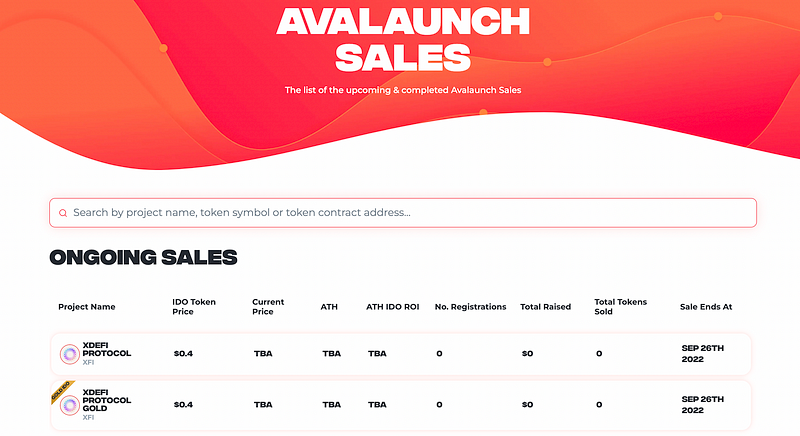
When viewing these pages, you will see two registration buttons instead of one. Next to these buttons, you will also see your eligibility for each sale displayed.
When viewing the Community IDO page, if you are also eligible for the Gold Staker IDO, your “eligibility” will be reflected next to both registration buttons.
Since each sale has its own page, clicking “Go to Gold IDO” the gold button will simply take you to the Gold Staker IDO sale page, where you can register as normal.
The Gold Staker IDO
The Gold Staker IDO for the Battle for Giostone sale is something we are particularly excited about and thrilled to be able to offer it to our very loyal Gold Staker community.
With the help of the Battle for Giostone team, we have secured a $150,000 allocation in the seed round which is what we will be offering to our Gold Stakers in this very special event. This Gold Staker IDO creates an opportunity for our Gold Stakers to participate in the earliest funding round, which historically excludes retail altogether, at the lowest pricing and valuation.
Part of our mission here at Avalaunch has always been to bring the community closer to the opportunities available only to VCs and private capital. This seed round allocation, now available to you, perfectly embodies this vision.
Additionally, you will also have full access to the Community IDO, should you choose to participate in both.
Gold Staker IDO User Guide
The biggest different between the Community IDO and Gold Staker IDO is that there will be no Validator Round and the Staking Round has been extended to a full 24 hours. This will provide our Gold Stakers ample time to come and claim their guaranteed allocation.
Again, worth noting is that Auto-Buy feature and the Booster Round are available for the Gold Staker IDO if you’d like to take advantage of those automations.
Eligibility and Registration
If you are eligible for the Gold Staker IDO, this will displayed next to the “Register for Gold IDO” button on both sale pages and the button will be active.
Conversely, if you are not eligible, the “Register” button will be disabled and your eligibility status will be marked as “Not Eligible.”
As mentioned above, if you are Gold Staker, there are a few important things to note:
- If you are a Gold Staker, you can participate in both sales (Community IDO & Gold IDO), using your full stake in both sales. This is great news for Gold Stakers as you essentially have double allocation power!
- If you have tokens locked for 12 months as a Gold Staker & also have tokens staked but not locked, only the locked tokens will be eligible for the Gold Staker IDO. For the Community IDO, your total stake (both locked and non-locked tokens) will count toward your allocation.
- The snapshot for the Gold Staker IDO was taken on 9/21/2022 at 2:00 a.m. (UTC). Only tokens locked at the time of the snapshot will be counted toward your allocation in the Gold IDO. Anything locked after will not be counted toward your Gold IDO allocation.
Claiming & Vesting
Like all of our IDOs, both the Community IDO and Gold IDO will have separate claim portals found in the Account section of the Application. Because the Gold Staker IDO represents an allocation in the seed round, it will have lower pricing per token and also different vesting terms.
Price and vesting details can be found in both the Info tab on the sale page and in the Battle for Giostone IDO Announcement.
While the vesting terms and price may be different, the initial token unlock will occur at the exact same time for both IDOs.
Wrapping Up
The Gold Staker IDO is a unique opportunity that in many ways embodies what Avalaunch is all about. Not only were we able to work very closely with the extremely talented Battle for Giostone team to secure this seed allocation for our community, but also on many aspect of the tokenomics, in-game economy and the fundamentals which represent the future potential of this groundbreaking game.
As always, if you have any questions about the Dual-IDO or any of the specifics regarding eligibility and participation, please feel free to reach out in the Avalaunch Telegram where our team will be more than happy to help with any questions you might have.
-
Battle For Giostone x Avalaunch: IDO Announcement
Introduction
Avalaunch is excited, for multiple reasons, to announce its next IDO — Battle For Giostone.
The Battle For Giostone sale is particularly special to Avalaunch because it breaks ground on a number of levels, including sale structure (with fair pricing as well as a specialized sale for Gold Stakers), a revolutionary in-game economy, and also the introduction of a highly popular game genre to the blockchain space. Battle For Giostone is Avalaunch’s deepest collaboration so far, where from inception, we were able to make strategic decisions alongside the project team.
As GameFi has emerged and continues its iterative march, there has been one set of titles missing from the mix — Multiplayer Online Battle Arenas (or MOBA). MOBA games such as League of Legends and DOTA2 are some of the most popular titles in traditional gaming, with enormous player adoption, tournament participation, community engagement and ongoing revenues.
Battle for Giostone represents a watershed moment for this genre — it is a project that has already seen significant development from a highly experienced team, with the goal of providing a slick and enjoyable gameplay experience on par with its contemporaries — but has also been designed from the ground up to ensure true player ownership of in-game assets as well as value sharing with its community.
The Battle for Giostone development team has exactly the right focus — this is a game built for MOBA gamers by MOBA gamers. Fun and compelling gaming is the primary focus of this project — there is a deep understanding that the value of a game is ultimately derived from its gameplay experience. To some degree (and in the best possible way) Battle For Giostone could be considered a MOBA game first, and a blockchain game second — but with all the powerful and compelling mechanisms of each.
Sale Structure
The fundraising space is a competitive landscape with a multitude of factors that can skew project valuations. Avalaunch is doubling down on its commitment to providing the best value it can for XAVA sale participants, and also to close the gap between public and private pricing. The Battle For Giostone sale (which is actually two sales in one — a community sale, and a Gold Staker sale) addresses these goals in very specific ways.
To begin, both the community and Gold Staker sales are priced at a very fair valuation, with a significant piece of the supply dedicated to liquidity provision on-chain. The Battle For Giostone sale is the first “dual” Avalaunch sale, in which one sale is available to the entire XAVA community, and the other is designed specifically for Gold Stakers. The Gold Staker sale is truly innovative in that it provides parity between seed round pricing and public pricing. As far as Avalaunch is aware, this is a first in crypto fundraising, successfully closing a long existing gap.
Game Overview
Since its beginning, the world has gone through many epochs and eras, enduring all kinds of natural and political disasters. Of course, all those events had an important story that helped humanity learn a new lesson. Nevertheless, each story finds its own new beginning, with previous events often long forgotten. Our story today is no exception.
Battle For Giostone is a MOBA game, steeped in lore, with compelling “gameplay first” mechanics. Read on for gameplay details.
The Battle
In Battle For Giostone, two teams of 5 players compete against each other to destroy a base defended by the opposing team (or to meet an alternate victory condition).
To destroy the enemy base, you will have to collect stones defended by the dragon Gio. Gio is a unique character that can spawn at a random time in the game, either at the top left or bottom right of the map. Once killed, Gio will drop a stone which a hero can then collect. If the hero holding these stones is killed it can be picked up by another hero who will then gain its power.
An Example BFG Map Strategies on the battle map are varied and will be familiar to most MOBA players:
Lanes —
There are three different lanes to take to the enemy base. Each lane has its own specific playing style. Once you decide what works best for your team you can start working on the strategy for the lane that most suits your playstyle and team makeup.
Shrines —
There are shrines located throughout each lane that will restore your health and mana without having to travel all the way back to your base. Your team can only use the one located on your half of the map so plan your last rest carefully. Shrines can be destroyed to slow the other team’s progress.
Towers —
Towers will attack all enemy Heroes in their range. You must destroy all enemy towers in the lane you are traveling on enroute to the enemy base.
To destroy the enemy base, you will have to collect stones defended by the dragon Gio.
After thousands of years, the Giostone wakes from its slumber. Ranvir, Akuma, Auri, Gurluk, Gogmangog, and Lucius are the 6 Heroes who could wield its power. Good or Evil? Salvation or Destruction? It’s your choice.
The Heroes
Each player controls a Hero with a set of unique abilities. They are separated into 6 hero classes (for more information about heroes and their associated stats, please visit here):
Melee Assassin (Akuma)
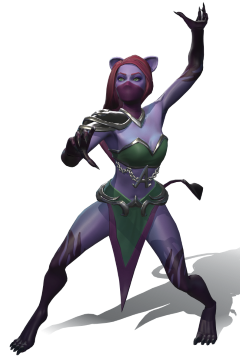
Akuma is a cold-blooded assassin who stops at nothing, never hesitating to use any and all her powers of persuasion to get what she wants. A consummate warrior who is more than willing to leave her life on the battlefield, she embodies the fierceness of a feral tiger and the cunning of a fox.
Ranged Assassin (Lucius)
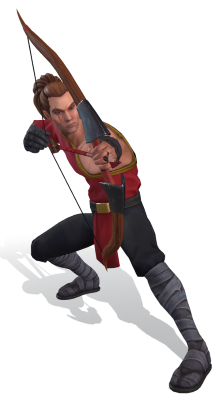
Lucius has spent lifetimes training with world-class archers to become the finest assassin in the known universe. An honorable and assiduous hero, he views his enemies as an extension of himself, grappling with his own destiny as their death breathes life force into him; bolstering his already vast array of skills. He has but one true nemesis and that is the wind — a floating wave of air, whose undulation continually varies. His name strikes fear into the hearts of those who oppose him and his arrow strikes are swift, piercing and always deadly.
Melee Wizard (Gogmangog)
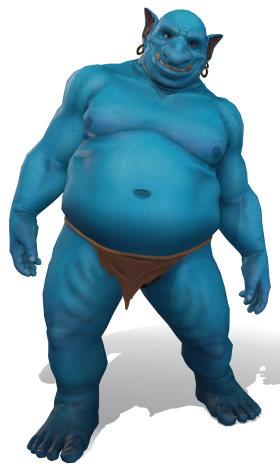
Gogmangog is a magical creature, who despite his brutish appearance, is a cunning and skilled master of the arcane arts. Inheriting his sorcerous talents from a long ancestral line of magi, Gogmangog wreaks vengeance on the battlefield due to his ability to combine powerful physicality with magical prowess.
Ranged Wizard (Gurluk)
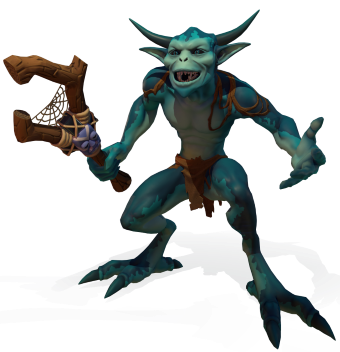
From the wizard branch, we have the infamous Gurluk; whose reputation truly precedes him. In the beginning, Gurluk’s origin story was one of great service. For a long period, he travelled around the world, liberating villages in times of disaster and giving everything to the people. He was truly selfless; never wanting anything in return but to be recognized as “their” wizard. However this philanthropic intent diminished as Gurluk became aware of the power of Giostone. Over time, the quest for Giostone has come to consume him.
Melee Warrior (Ranvir)
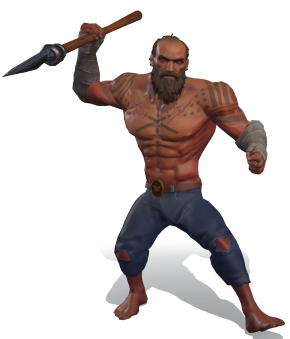
A beast — even though he looks like a human, Ranvir fights like a beast. A one-of-a-kind battlefield strategist who is in complete meditative control of his body and mind, Ranvir will analyze, plan and utilize his surroundings to take advantage in any fight. Possessing inordinate agility for his size, Ranvir overwhelms his opponents with brawn, wit and speed.
Ranged Warrior (Auri)
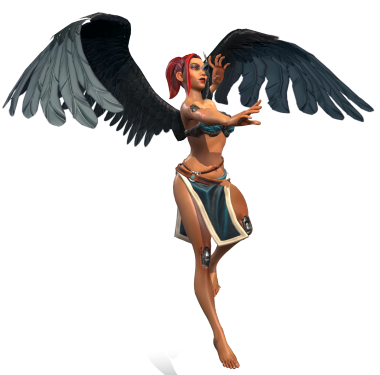
Appearing as a beautiful humanoid with broad wings and draped in silk, many assume Auri has angelic intent — but looks can be deceiving. In fact Auri is a fearsome warrior whose dedication to destruction saw her augment her legs and arms with titanium apparatus. Swift and agile as a breeze, whilst delivering flurries of crushing blows, when you see her it is already too late.
Game Play
Each hero can be forged with 4 abilities out of 72 choices which means there are combinations for every style of play. The abilities are then slotted in one of the 4 areas of the hero (hands, legs, body, and head). To take this a step further each ability also has a rarity from common, rare, or legendary and has a cooldown after use. The combination of having to fine tune your hero’s ability to your playstyle and to your team will keep players adjusting to new meta as the gameplay evolves over time.
More information about the range of abilities used to forge your heroes can be found here.
Players should note that heroes always start the battle at Level 1. During the game, they can level up to level 10 by killing creeps and heroes. Each level gained will open additional main and/or ranged attribute stats.
Every battle will take place against other players in 5 vs 5 matches, but you will also be able to play a Story Mode in the future. By playing the Story Mode, you will encounter and battle unique creatures that drop materials for the production machine. The production machine will offer you the option to produce new heroes (NFTs). There are 72 total abilities and players will have determine which combination will best serve their new heroes when minting these NFTs. Additional information on these will be available closer to release.
Full gameplay highlights from the pre-alpha:
In-Game Economy
Battle For Giostone includes a number of P2E mechanisms, all of which are based in a revolutionary model for sustainable economic activity. The idealized notion that value is shared through gratuitous emissions, without real underlying activity support it, is hopefully, passé.
The BFG economy has been carefully designed, and allows for a looped economic system, where Gamers bring revenue to Investors, and Investors bring revenue to Gamers, within a mutually beneficial architecture.
A schematic of the BFG in-game economy (some of these values may change)
Some features of the BFG economic cycle:
- Earning NFTs are forged by BFG holders, where BFG gets locked — entitling them to rewards generated from economic activity within the game.
- Forging NFTs exercises a tax where funds are placed into the Player Rewards pool, creating non-inflationary yield.
- The Player Rewards pool is used to reward skilled champions playing Battle For Giostone.
- Within this gameplay loop, players may receive modifiers that boost the earning power of NFTs, which can be sold in the secondary marketplace (tokens flow to players).
- BFG producing NFTs are seniority based so longer-term users are always first to earn. Depending on the flow of rewards coming into the system, an NFTs earning power will vary.
Overall, the BFG economy is designed to allow players to enjoy the gameplay while rewarding those most skilled in the game. It is not a DeFi protocol dressed up as a game. Skilled users can receive additional rewards as a function of play and play only. Moreover, investors are incentivized to forge NFTs that add to the player reward fund, and invest in boosting modifiers to improve their own yield.
There is a second tokenized asset, GIOS, which lives off-chain to effectively function as in-game credits. Players can only earn GIOS through gameplay and it will not be tradable on exchanges. The primary purpose of GIOS is to forge new Heroes. Though there may be a modest conversion rate to BFG, the rate will be purposefully high to stimulate players to forge new heroes.
The ultimate motivation behind this design is to enhance the existing gameplay experience for players into something that is uniquely Web3 oriented, whilst at the same time provides for the familiar sense of enjoyment found in traditional gameplay experiences.
Ways to Earn:
- Battling against other players to earn rewards for maintaining a spot as one of the top players on the leaderboard
- Fighting against different creatures to collect parts for the Production Machine and producing new heroes
- Collecting rare heroes
- Collecting and selling modifier drops and other rare items which boost Investor yield
Battle For Giostone— Links and Team:
Website | Twitter | Discord |Telegram | Medium | YouTube | Reddit | TikTok | Facebook | Instagram | Whitepaper | LinkedIn
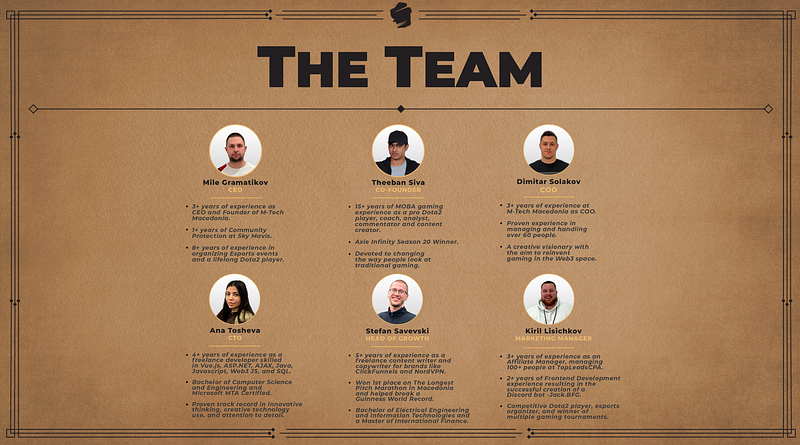
Partners & Backers
“Battle For Giostone has been a dream project for us to work with. The team is truly determined to harness their passion as MOBA gaming professionals and software developers to create a Web3 gaming experience that capitalizes on the dynamicism of tokenized assets and embodies the ethos of shared value in a decentralized world. We feel fortunate to have met them so early and participated every step of the way.” —Avalaunch
Closing Thoughts
The Battle For Giostone sale represents a refinement of the Avalaunch product offering, exhibiting a number of new innovations. Some of these are sale oriented (i.e. the first dual sale, the first sale that rewards Gold Stakers with seed round access) and some are product oriented (i.e. the first MOBA game on Avalanche, designed around a revolutionary in-game economy).
The Battle For Giostone team are bringing an already well developed product to market, which is oriented around a “gameplay first” design — a concept which we believe will ensure sustainable success. Overall, Battle For Giostone is poised to exist as an innovator and shining example in a GameFi space which, whilst still finding its bearings, will crown its winners as the new champions of digital recreation.
The First Gold Stakers Sale
As mentioned earlier, Avalaunch is thrilled to have secured a 150K allocation in the BFG seed round for Gold Stakers. This watershed event creates an opportunity for our Gold Stakers to participate in the earliest funding round, which historically excludes retail altogether, at the lowest pricing and valuation.
Eligibility
The snapshot for the Gold Staker IDO was taken on 9/21/2022 at 2:00 a.m. (UTC). This means if you had tokens locked for 12 months at the time of this snapshot, making you a Gold Staker on the platform, you are eligible to participate in this very special Gold IDO.
Only tokens staked at the time of the snapshot will be counted toward your allocation in the Gold IDO.
In Summary:
- ~4.5M BFG will be made available to Gold Stakers (150K USD), representing 3% of the total supply.
- The fully diluted value of 5M USD is perhaps the lowest in crypto for a credible project—in both private and public funding circles.
- Participants will be afforded the same pricing and be subject to the same vesting terms as seed investors.
- Vesting: 10% at TGE, 6 month-cliff, linear vesting for 12 months.
- Gold stakers are additionally welcome to participate in the Community IDO, with their full allocation power in both.
Please reference the registration and sales schedule in order to be aware of the windows to participate and there will be forthcoming notice on the very basic instructions required to take part.
Avalaunch believes that their long-standing partnership with BFG and respective commitment to deliver value to supporters are being realized. It is the aim of Avalaunch to offer similar arrangements going forward as well as forge deeper partnerships with like-minded teams across the Avalanche ecosystem.
Funding Numbers:
Total Supply: 150M BFG Tokens
- Seed — 300K — 9M BFG at .0333 USD
- Gold Stakers — 150K — 4.5M BFG at .0333 USD
- Private — 650K — 15M BFG at .04333 USD
- Avalaunch IDO — 250K — 4.6875M BFG at .0533
Note: Numbers are rounded slightly.
Total Raise: 1.35M USD*
*Please note that the team is responsible for an additional 500K USD capital injection and owns a software development company which has enabled them to optimize development costs.
Supply Breakdown & Vesting
Total Supply: 150M BFG
- Player Rewards: 30M BFG (20%)
- Team: 30M BFG (20%)
- Ecosystem Fund: 22.5M BFG (15%)
- Liquidity — 15M BFG (10%)
- Private Round: 15M BFG (10%)
- Reserve: 9.562M BFG (6.375%)
- Seed: 9M (6%)
- Advisors: 7.5M BFG (5%)
- Avalaunch IDO: 4.6875M BFG (3.125%)
- Gold Stakers: 4.5M BFG (3%)
- Airdrop Fund: 2.25M BFG (1.5%)
Vesting Following TGE:
- Player Rewards: 3 month-cliff, linear daily vesting for 48 months
- Team: 12 month-cliff, linear daily vesting for 36 months
- Ecosystem Fund: 3 month-cliff, then discretionary, first unlocks slated for tournaments.
- Private Round: 10% at TGE, 6 month-cliff, linear vesting for 12 months
- Liquidity: — Discretionary unlock, likely to be fully deployed within 9 months
- Marketing Fund: 3 month-cliff, linear daily vesting for 36 months
- Reserve: 6 month-cliff, linear vesting for 6 months
- Gold Stakers (Seed Round): 10% at TGE, 6-month cliff, linear vesting for 12 months
- Advisors: 12 month-cliff, linear daily vesting for 24 months
- Avalaunch Community IDO: 100% unlocked
- Seed: 10% at TGE, 6 month-cliff, linear vesting for 12 months
- Airdrop Fund: Discretionary unlock
Other:
- Initial Circulating Supply: 7.5375M BFG (excluding liquidity)
- Initial Market Cap: $402K USD (excluding liquidity)
The Battle For Giostone IDO on Avalaunch
- Gold Stakers Round: 4.5M BFG @ .0333 USD ($150K USD)
- Avalaunch IDO: 4.6875M BFG @ .05333 ($250K USD)
Registration Schedule:
- Registration Opens: September 25th at 3:00 p.m. (UTC)
- Registration Closes: October 3rd at 6:00 p.m. (UTC)
Sale Schedule:
Community IDO:
- Validator Round Begins (Community IDO Only): October 4th at 6:00 a.m. (UTC)
- Validator Round Closes(Community IDO Only): October 4th at 3:00 p.m. (UTC)
- Staking Round Begins: October 4th at 3:30 p.m. (UTC)
- Staking Round Closes: October 5th at 6:00 a.m. (UTC)
- Booster Round Begins: October 5th at 6:00 a.m. (UTC)
- Booster Round Closes: October 5th at 10:30 a.m. (UTC)
Gold Staker IDO
- Registration Opens: September 25th at 3:00 p.m. (UTC)
- Registration Closes: October 3rd at 6:00 p.m. (UTC)
- Gold Staker Round Begins: October 4th at 6:00 a.m. (UTC)
- Gold Staker Round Closes: October 5th at 6:00 a.m. (UTC)
- Booster Round Begins: October 5th at 6:00 a.m. (UTC)
- Booster Round Closes: October 5th at 10:30 a.m. (UTC)